
Introduction#
When we speak about how the I Ching was first introduced in the West, one of the most well known figures in this context is the great 17th century German mathematician Gottfried Wilhelm Leibniz, who learnt about the I Ching through his famous epistolary correspondence with a Jesuit missionary in China. This article, however is not about Leibniz and his connection to the I Ching, but about someone else who was contemporary to Leibniz and also famously associated with the city of Leipzig- Johann Sebastian Bach. In this article we will investigate the unexpected connections with this famous Baroque composer and the I Ching.
Caveat: Before we proceed, and for the sake of rigor, let me clarify that while Leibniz - who lived in the same city just a few years before Bach - was fascinated by the I Ching’s binary mathematics, Bach himself likely never even knew of the Book of Changes. Yet, no one can stop us from looking at Bach’s life and musical works through the lens of the I Ching, and our exploration starts with Gematria.
🎵 Listen in the background: Contrapunctus 14 (J.S. Bach)
Bach and Gematria#
Gematria is a form of numerology that assigns numerical values to names or phrases to reveal their occult meanings. It is a central practice in Judaic Kabbalah and although there is no evidence that European thinkers and artists like Newton and Bach practiced it in the strict mystical sense, they had a profound interest in it.
Newton for example, who is well-known as a mathematician and physicist, actually devoted more time to the numerological study of biblical scripture than to physics. And Bach is known to have integrated numerical symbolism into his musical compositions, although this is subject to some academic controversy.
On the one hand, the idea that Bach encoded certain numbers - namely 14 and 41 - into his music via alphabetical gematria was popularized in the mid 20th century by the German theologian and musicologist Friedrich Smend. On the other hand, scholars like Dr. Ruth Tatlow (author of Bach’s Numbers: Compositional Proportion and Significance, Cambridge University Press, 2015) have challenged Smend’s gematria theories. Tatlow argues that Bach used “proportional parallelism” (creating mathematical harmony between the number of bars in different sections) rather than spelling his name with numbers.
This should not detract from our purpose here, because while traditional musicology debates how literally Bach used 14 and 41, the numerical motifs undeniably exist in his works (like the 14 canons in the Goldberg Variations), making the archetypal connection to the I Ching valid regardless of his conscious intent. Furthermore, gematria is a practice that resonates with the I Ching’s emphasis on number as a carrier of meaning.
The Origins of 14 and 41#
Bach used alphabetical numerology (where A=1, B=2, C=3, etc.) to embed his name into his compositions.
Number 14 (BACH):
Calculated as B(2) + A(1) + C(3) + H(8) = 14. This represents his earthly identity and craft. He famously left The Art of Fugue unfinished at bar 14 of the final fugue, which spells out his name in notes (B-flat, A, C, B-natural).
The number 14 (BACH), being derived from the family name alone, represents Bach the man, the craftsman, and the composer. It is his finite, human signature embedded within the infinite complexity of the work. In Bach’s Lutheran context, the surname signifies the earthly lineage, the human craftsman, and the mortal identity. It is the “flesh” signature and one could also say, his “unfinished” signature, of which the most profound example is in The Art of Fugue. The final piece, Contrapunctus 14, breaks off exactly at bar 239 (2+3+9=14). At this precise moment, Bach introduces the B-A-C-H motif (his name) as a subject. The music stops mid-measure, symbolizing that the “self” (14) has reached its limit and death has interrupted the work.
Number 41 (JSBACH):
Calculated as J(9) + S(19) + B(2) + A(1) + C(3) + H(8) = 41. This represents his “complete” self, often interpreted as the individual (Bach) serving the divine. By adding the initials J and S, Bach invokes his complete name (identity), which he famously dedicated to God (Soli Deo Gloria). The inclusion of the given names elevates the number from a mere family label to a complete soul standing before the Divine.
Notably, 41 is 14 reversed, mirroring Bach’s frequent use of retrograde (backwards) counterpoint, symbolizing the reflection of the human in the divine and vice versa.
The Interaction of 14 and 41#
If 14 is the human looking forward into the world, 41 (the reverse) symbolizes the human turning backward or upward toward God. One could ask, in the context of numerology, why it must be that 14 represents his earthly identity and 41 his soul devoted to God, and not the other way around.
If 41 were the “earthly self” and 14 the “divine,” the symbolism would imply that adding his initials (J+S) reduces him to a simpler, earthly state, which contradicts the theological intent of expanding one’s identity to include one’s Christian vocation. The movement from 14 to 41 is an expansion (adding J+S), mirroring the spiritual journey of adding faith and vocation to one’s natural birth. Scholars note that Bach often used 41 in contexts explicitly linking him to the Trinity or the Holy Spirit (e.g., a motet with 123 bars, where \(3 \times 41 = 123\), linking “3” for the Trinity and “41” for Bach). This confirms 41 as the number of the spiritually integrated self, not the base earthly one.
In summary, 14 is the root (the earthly man), and 41 is the flower (the man fully realized in God), with the reversal serving as the musical metaphor for spiritual reflection.
Bach’s Signature Numbers viewed through the lens of the I Ching#
If we map Bach’s signature numbers to the I Ching, the meanings align astonishingly well with his spiritual philosophy.
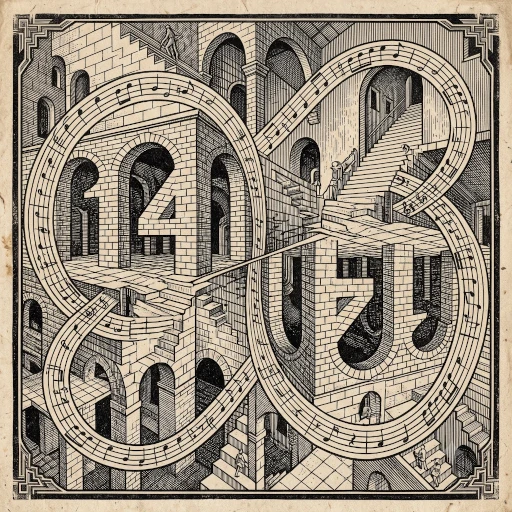
Hexagram 14 - 大有 Ta Yu (Great Possession), composed of the trigrams Fire over Heaven, is the sun at its zenith, symbolizing abundance, wealth, and clarity, but more concretely, this hexagram emphasizes that “great possession” requires humility and stewardship; talent is a gift to be shared. This perfectly mirrors Bach’s philosophy of Soli Deo Gloria (To God alone be the glory). His massive output (the “great possession” of music) was managed with rigorous discipline and intended for the service of the church and the enlightenment of listeners, not merely for personal fame.
Hexagram 41 - 損 Sǔn (Decrease), composed of the trigrams Mountain over Lake, symbolizes decrease, simplification, and sacrifice. It suggests that to strengthen the spiritual (the mountain), one must decrease the ego or the material (the lake). It is about refinement through subtraction.
This resonates with the rigorous constraints of counterpoint and fugue. Bach often “decreased” musical freedom by imposing strict mathematical rules, yet this limitation resulted in spiritual “increase.” The number 41 being the reverse of 14 also aligns with Hexagram 41’s theme of inversion: decreasing the lower to benefit the higher, just as Bach reversed his musical themes to reveal hidden divine order. In fact, this is the exact definition of Bach’s counterpoint! Bach intentionally “decreased” raw musical freedom and untamed impulses, subjecting them to the strict, rigorous rules of mathematical fugues, in order to achieve an elevated, spiritual architecture.
The Alchemy of 5#
Numerologically, 14 and 41 both reduce to 5. The equations \(1+4=5\) and \(4+1= 5\) introduce a third dimension: synthesis. In both systems, the number 5 acts as a dynamic resolution between possession (14) and decrease (41).
Let’s consider the narrative: an artist is given immense talent or “great possession” - this is Hexagram 14. The artist cannot let this talent run wild. You must tame your impulses, decrease your ego, and do the rigorous, earthly work of building structure, which for Bach meant the strict mathematical rules of counterpoint. These restrictive mathematical rules are the embodiment of Hexagram 41. Once the artist builds the structure, he cannot force the art to come alive or demand that God immediately bless it (divine grace).
In Lutheran theology, which Bach adhered to, the number 5 frequently symbolized the five wounds of Christ. Bach often used groups of five notes or five-part textures to subtly reference suffering, grace, and redemption (e.g., the “five-note sigh” motif in the St. John Passion). Bach’s sets often imply a completion at number 5 or 6. For instance, his Partita No. 5 is often noted for its expansive, almost improvisatory nature, serving as a central pivot in his keyboard collections. Therefore in Bach’s music, 5 represents grace and the perfect fifth - the ultimate harmonic stability.
In the I Ching, Hexagram 5 is Hsü (Waiting or Nourishment). Wilhelm explains that Hexagram 5 signifies that “all beings need nourishment that comes from above,” but crucially, “the giving of food has its time which must be waited for”. In this framework, Hexagram 5 represents the active, prepared state of the artist. The artist has done the hard work of decreasing the ego (41), and now he must wait for the “nourishment from above” to fill the structure he has built. Hexagram 5 is the state of maintaining inner strength while the storm gathers: “movement in the midst of danger… without letting oneself be lulled into the tranquility of rest” (Wilhelm).
This narrative weaving hexagrams 14, 41 and 5 together is pointing to the Taoist concept of Wu Wei or “effortless action”, although this epithet can be misleading. People often misunderstand Wu Wei as simply doing nothing or letting raw nature run its course. But if you only have Hexagram 14 (Great Possession / raw talent and energy), acting purely on instinct leads to ego-driven chaos. Raw talent without structure is not Wu Wei; it is just noise. To achieve effortless action, you must first do the hardest work of all: get your ego out of the way. This is Hexagram 41 (Decrease). Wilhelm states that this requires the “taming of impulses” and the sacrifice of the lower self for the higher spiritual life. You are literally “decreasing” your conscious, forcing will so that a higher natural law can take over. Once the ego is decreased and the structure is built, you reach Hexagram 5 (Waiting/Nourishment). Wilhelm explicitly clarifies that this waiting “does not mean an abandonment of the enterprise… the work will be carried out”. This is the very definition of Wu Wei: it is a state of supreme, active receptivity where the work accomplishes itself without your forced interference.
Stating that Bach was a conscious practitioner of Wu Wei would, of course, be historical speculation. But considering his prolific and almost supernatural musical genius, how else could he have produced such a divine volume of work if not through the ’effortless action’ of Wu Wei? In the I Ching, Hexagram 5 teaches that ‘all beings need nourishment that comes from above,’ but that this rain cannot be forced; it must be waited for. Bach built the rigorous mathematical vessels of his fugues, but he did not force the music. He simply prepared the ground, decreased his ego, and allowed the divine rain of inspiration to effortlessly fill the structures he built.
References#
Tatlow, R. (2015). Bach’s numbers: Compositional proportion and significance. Cambridge University Press.
Wilhelm, R. (1975). I Ching: El libro de las mutaciones (D. J. Vogelmann, Trans.). Editorial Sudamericana.