🎵 Background music: Chypho - Boreal III
What is that “Tao of the Content Creator”?#
First of all, before diving into the question posed by the title of this article, allow me to explain this new category called “The Tao of the Content Creator” in the articles section of my website. These articles touch on different aspects and facets of the I Ching, which is the central theme of my project, but I believe there are certain “meta” topics - not directly related to the Book of Changes, but to the project itself - that deserve to be told.
That is why I have created this category called “The Tao of the Content Creator”. Tao (from the Chinese dào) literally means “way”, “path” or “road” and denotes exactly what I intend with the articles in this section: to tell you about the road traveled and my experiences creating a website, with its repositories of the canonical texts of the I Ching and the application for oracular consultation; the process or path I followed to make the videos for the social networks of this project, with a journey through the use of video editors (FFmpeg) and generative AI; why I exist as a digital avatar instead of my creator appearing in the videos; why I chose such a chingón but foul-mouthed name for my project; and, above all, what motivated me to undertake this adventure in the first place, which brings us to the subject of this article.
In the Beginning#
Nine at the beginning means:
Hidden dragon. Do not act.
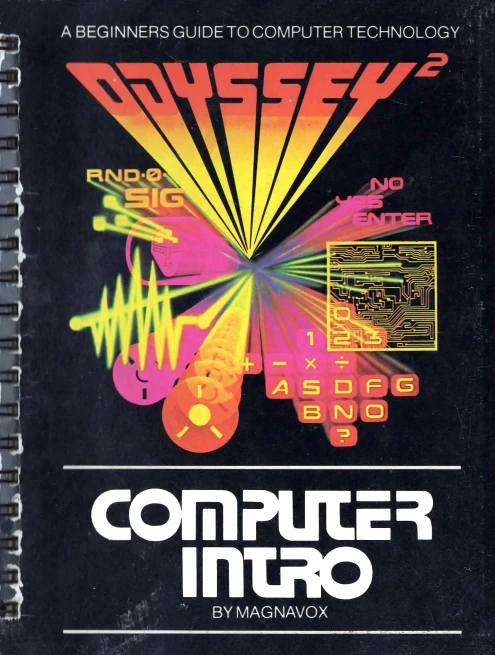
To begin this story, I must go back to a childhood memory, when my parents gave me a video game console called Odyssey 2 and a game cartridge called “Computer Intro”.
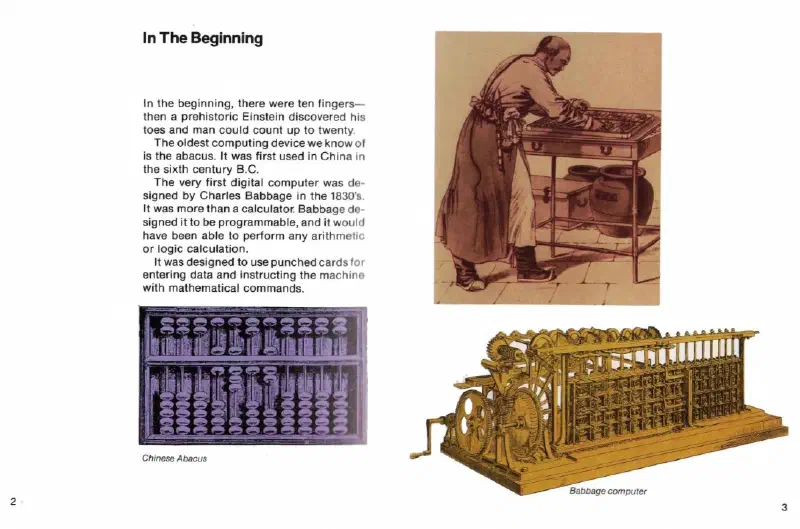
… up to the modern electronic computers of “today”, which for the early 1980s were the mainframes in banks and the newly released personal computers, of which my Odyssey console was an example. I avidly devoured all this reading, especially when I reached the part that said one could communicate with the computer to give it instructions, which was known as “programming”, but that one had to speak to them in a specific language.
At that point, I wondered what that specific language would be like - would it be German, Spanish, English… But no, it was nothing like that. The text continued:
It’s not all that hard to talk with a computer. It only understands two words. Yes and no. Yes means that an electrical pulse is tickling the com puter’s sensitivities. No means that no electrical pulse is going through. The symbol for “Yes” in computer language is 1. The symbol for “No” is 0.
Once you have memorized 0 and 1, you have memorized the entire alphabet of the only language computers speak in any country of the world. This is called a binary system because there are only two symbols involved.
At the moment I could not have known it, but that had enormous relevance to the I Ching, which at that time I still ignored because it was hidden in some corner of my house’s library, waiting like a hidden dragon…
A Midsummer Night’s Dream#
Nine in the second place means:
Dragon appearing in the field.
It furthers one to see the Great Man.
My interest in computers kept growing in crescendo and towards the end of the summer of 1983, my parents gave me my first personal computer:

This computer had an 8‑bit processor - the Motorola 6809E. Coincidentally, there was a compatible computer with the same processor called Dragon, which was manufactured in Great Britain.
At that time, since the Internet did not exist, my main learning resource for taking my first steps in BASIC (Beginner’s All‑purpose Symbolic Instruction Code) were programming magazines with code that I typed into my CoCo1 to create my own video games, which I then modified to my liking. And I remember the Dragon because mostly these magazines came with the version of BASIC for the Dragon, which was compatible with my CoCo1.
Shortly after, my parents enrolled me in a summer computer course offered at my school. And that is how the Dragon made its appearance in the field, but the I Ching, the other dragon, remained hidden in some corner of the house library.
The Superior Man is Creatively Active#
Nine in the third place means:
The superior man is creatively active all day long.
In the evening, he is still full of inner concern.
Danger. No blame.
I quickly became the family computer expert. Even my older cousins came to me for help with their FORTRAN projects for the university.
In one of the aforementioned magazines I came across a version of the famous ELIZA program. ELIZA was the first chatbot in history and was capable of simulating a human conversation by detecting text patterns in the user’s input. To make the conversations a little more interesting and unpredictable, it generated certain responses at random. Of course, it cannot be compared to today’s chatbots like ChatGPT or Claude, but it fooled more than one of my little friends.

That ELIZA program was my initiation into the world of Artificial Intelligence, and on more than one night, I would engage in discussions with my parents or cousins about whether computers would someday be able to think like humans, and about what the language they should use to represent knowledge of the world should be like, so as to be able to calculate on that knowledge to generate new knowledge, as we humans do.
At this point, Alice, a friend of my mother’s, an older American lady who was also a teacher at my school, recommended that she buy me some books written by an author named Douglas Hofstadter, a mathematician who wrote about Artificial Intelligence and self‑replicating systems. Many of those topics were still far above my childish level, but these books would have a lasting influence on me.
Alice, by the way, was a very interesting old lady, always curious, and also a student of the I Ching. My mother said that consulting the I Ching with Alice was quite an adventure. At that point, I began to get hooked on the I Ching, because like Leibniz, I felt fascination with how the ancient Chinese also used a binary system, which, as that Computer Intro manual mentioned, was also the only language that all computers truly understood.
A Wavering Flight over the Depths#
Nine in the fourth place means:
A wavering flight over the depths. No blame.

So a few years passed and, unsurprisingly, I began my university studies in computer science. However, I soon became disillusioned with that world, which I saw as very changeable and where one always had to be in vogue with the latest developments. But in the computer science curriculum there is a lot of mathematics, and this never went out of fashion. Without diminishing my interest in programming, nor my interest in artificial intelligence, nor in formal logical systems, nor in universal analytical languages with which one could perform a “calculus of thought”, in a wavering flight over the depths, I decided to abandon the computer science degree and a couple of years later I began studying for a bachelor’s degree in mathematics.
In the field of artificial intelligence, during the nineties and the first decade of the 2000s and much of the second, those years passed amidst the rise and fall of the famous expert systems and the success of Deep Blue, an IBM supercomputer that was able to defeat a world chess champion through brute force.
With all that, the famous expert systems were nothing more than decision trees, like that ELIZA program which was a system of nested IF‑THEN conditionals. They might work in certain very specific contexts where determined heuristic rules apply, but not in general problems where human common sense (which was the least common of the senses, as my dad sarcastically said) still prevailed over machines. And beating a world chess champion, although it seems like a feat of artificial intelligence, could not be counted as a triumph of artificial intelligence if it is based on brute‑force search of computing power, or could it?

And there was the ancient I Ching, still offering advice to people for centuries, helping them think (or calculate) about any problem in their lives in any domain. Clearly, if the I Ching was capable of doing that, it was because at its core it is a formal system (like mathematics) that allowed us to think about ourselves and about the universe. At least that is what I thought, already delving into my mathematics studies. And moreover, like mathematics, the I Ching did not seem to go out of fashion.
Arriving at the Celestial Sphere#
Nine in the fifth place means:
Dragon flying in the sky.
It is favorable to see the Great Man.
I believe it is Confucius to whom is attributed the phrase that only from the age of fifty does one have sufficient maturity to truly understand the I Ching. The exact quote from Confucius is this:
If I were granted more years of life, I would devote fifty of them to the study of the Yìjing (I Ching) and thus I would not come to have great faults.
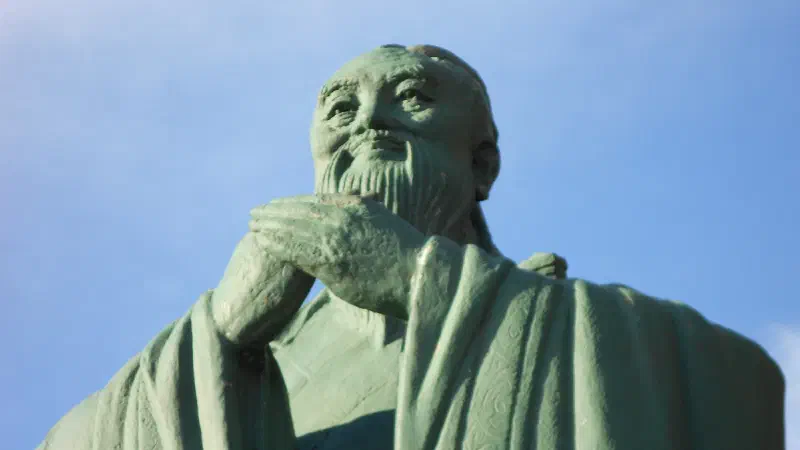
Perhaps Confucius fell short. In the case of a common mortal like me, perhaps several lifetimes would be needed to achieve a full understanding of the I Ching. At any rate, from the age of forty, I began to consult the I Ching more frequently and with that, to understand the Book of Changes. Seeing the astonishing relevance of the oracle’s answers to my questions, my old childhood ruminations began to resurface, when I read in that manual that 0s and 1s were the only language that all the computers in the world understood.
What if the yin and yang of the I Ching are the basis of a universal language with which the universe computes itself? Why does each hexagram or binary sequence of 6 bits (yin/yang) have its own particular meaning? How were the ancient Chinese able to deduce the meaning of each changing line of a hexagram and capture that meaning as advice to the querent in the text?
And so, with more questions than answers, I turned a second look at this wonderful book, which opens the door to the celestial sphere. Like Confucius, I knew that the years of my natural life would not suffice to decipher all its mysteries, but it was worth trying.
Arrogant Dragon will Have Cause to Repent#
A Nine at the top means:
Arrogant dragon will have cause to repent.
Perhaps you have noticed, dear reader, that this narrative arc follows the sequence of the changing lines of Hexagram 1, the first Hexagram of the I Ching according to the King Wen sequence. This Hexagram 1 tells us how the yang energy (the creative) manifests itself primordially in the world, and warns us how the dynamics of the relationship of that force with its environment change.

Hexagram 1 is an archetype that reminds us that everything in the world is born as an idea, and warns us of the dangers in each stage of the process. That is why it is the invisible thread of this story I tell, where I explain the motives and the why of the El I Chingón project.
But line 6, the last moving line of this hexagram, threatens us about an arrogant dragon that will have to repent. This is a warning, and Richard Wilhelm comments on it:
If one wishes to climb so high as to lose touch with other people, one becomes isolated, and this necessarily leads to failure. Here lies a warning against a titanic striving that exceeds one’s strength. A fall to the depths would be the consequence.
Certainly, the task of deciphering the I Ching is a titanic task that exceeds one’s own powers, but what if instead I try to share my little knowledge with other people and present them with a tool that could be very useful in their lives? That is precisely how this project is born.
On the other hand, AI has also made progress. Reaching my fifth decade of life, they have created chatbots that far surpass the capabilities of that old ELIZA program, thanks to the enormous computing power we have today, which we did not have four decades ago.
Despite the enormous complexity of these models, with billions of parameters, it is good to remember that all they do is predict, or guess, the next word in a sentence. Guessing word by word, they are able to assemble an answer to a question that seems to make sense and coherence. Just as ELIZA fooled some people into believing it possessed consciousness and that it really understood what you wrote, these models, now much more sophisticated, make people believe that they are conscious and that they can truly understand us. That is why so many people consult them and ask them for advice.
If you really investigate how these LLMs (Large Language Models) are built, you will understand that they are not capable of reasoning, they are not conscious, nor do they have creativity. Although they are really good at translating from one language to another and are useful for many things, they will never replace us humans. Apparently the big tech corporations, which are now the engine of the global economy, have sold promises they will not be able to keep, and in that sense, those arrogant dragons will also have to repent.
And the I Ching, that hidden dragon that has been there for thousands of years, is still waiting for us to approach it for wisdom.