The connection between the I Ching (or Yijing) and the Japanese creation myth of the Kojiki is a fascinating example of how Chinese thought influenced the construction of Japanese cosmogony. In fact, the Kojiki is the oldest known historical book about the history of Japan. On the other hand, the origin of the I Ching is lost in the mists of time. Furthermore, the authors of the Kojiki borrowed concepts and terms from the I Ching itself.
The most direct and conclusive evidence of this is found in the very preface of the Kojiki, which describes the beginning of the world using expressions of clear Chinese origin. The preface refers to this process as kenkon shobun (乾坤初分), meaning “the initial separation of yang and yin.” Here, “Ken” (乾) and “Kon” (坤) are the Japanese readings of the first two hexagrams of the I Ching: Qián (乾), which represents Heaven, the Creative, pure Yang energy; and Kūn (坤), which represents Earth, the Receptive, Yin energy.
The preface also uses the expression tenchi kaibyaku (天地開闢), meaning “the opening of Heaven and Earth.” This idea of a primordial division that gives rise to order is the very heart of Hexagram 1 (Qián) of the I Ching.
This demonstrates that the compilers of the myth not only knew the I Ching but also used its core vocabulary to describe the very act of creation. The “initial separation of yang and yin” is the fundamental cosmogonic principle for both the I Ching and the worldview that the authors of the Kojiki sought to project.
Furthermore, both the I Ching and the Kojiki myth begin from a state of chaos or undifferentiated void. Creation, in both traditions, is not an act of creatio ex nihilo (creation out of nothing), but rather a process of differentiation and separation. The I Ching explains that from the Taiji (the Supreme Ultimate) emerge Yin and Yang. From the interaction of these two primordial forces, everything else is born. The preface of the Kojiki reflects this same logic by describing the beginning as the separation of Heaven and Earth, an idea that resonates directly with Hexagram 1 (Qián/Heaven) and Hexagram 2 (Kun/Earth).
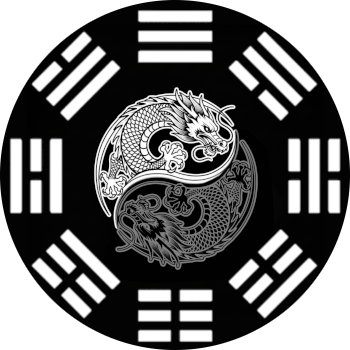
Academic studies indicate that the construction of the Japanese creation myth, especially in the Nihon Shoki (another official chronicle), was heavily influenced by concepts related to the I Ching, such as the Taiji (Supreme Ultimate), Yin/Yang (the two complementary forces), Qiankun (Heaven and Earth), Sancai (three powers: Heaven, Earth, and Man), and the Bagua (eight trigrams). The scholars of the Japanese court during the Nara period (710–794 AD) were deeply familiar with Chinese philosophy and used it as an intellectual framework to structure and make sense of their own traditions.
In this Youtube Short
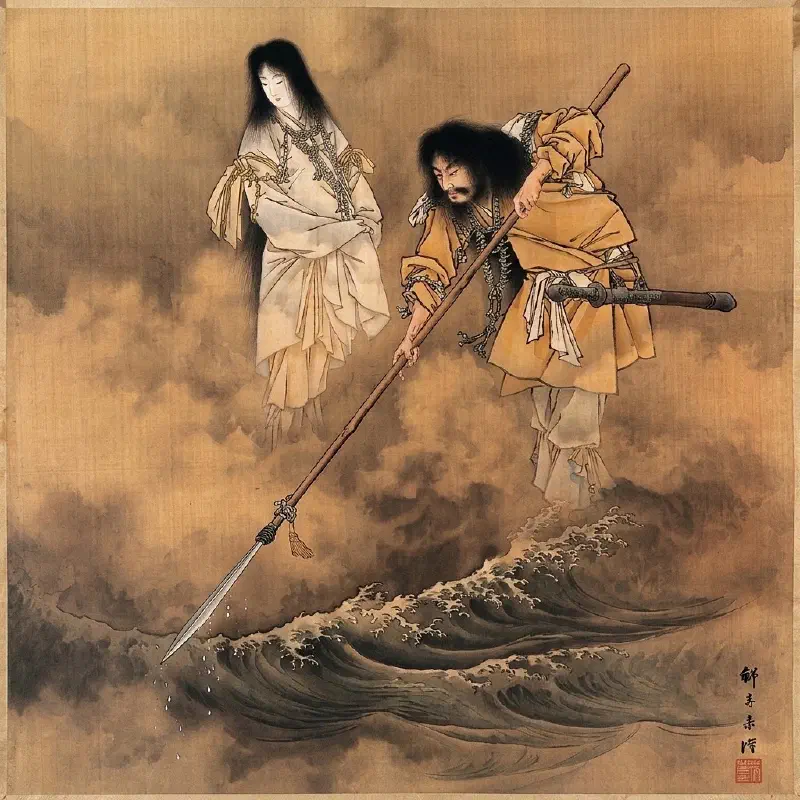
I have tried to capture the symbolic essence of Hexagram 1 and its relationship with the Japanese creation myth in the Kojiki. The image is inspired by a painting showing the Japanese deities Izanagi and Izanami, parents of Amaterasu, creating the Japanese archipelago.
It is an animated representation of the canonical text of Hexagram 1 itself:
Great indeed is the sublimity of the Creative, to which all things owe their beginning and which penetrates all Heaven.
The clouds pass, and the rain acts, and all individual beings flow, taking form.
Possessing great clarity about end and beginning, and about how the six steps are completed and become whole each in its own time, the holy man rides upon them as upon six dragons toward Heaven.
As for the aesthetics, it is based on surrealist paintings by artists such as Salvador Dalí and René Magritte. I consider surrealism to be the most suitable way to represent concepts that reach directly into the subconscious - the very realm where an oracle like the I Ching operates.
Musically, I was also inspired by Kitaro’s album of the same name: Kojiki.