The I Ching, or Book of Changes, is undoubtedly one of the fundamental texts of Chinese thought. Its influence extends to politics, military strategy, medicine, and the arts (Legge, 1996). Given such cultural weight, it is worth asking whether there is any relationship between its philosophical, aesthetic, musical, and narrative principles and one of China’s most iconic artistic manifestations: Peking Opera (Jingju). The short answer is yes, and in this article, we will explore the keys to this fascinating connection.
Yin-Yang as Vital Rhythm#
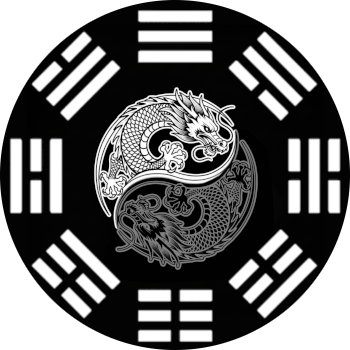
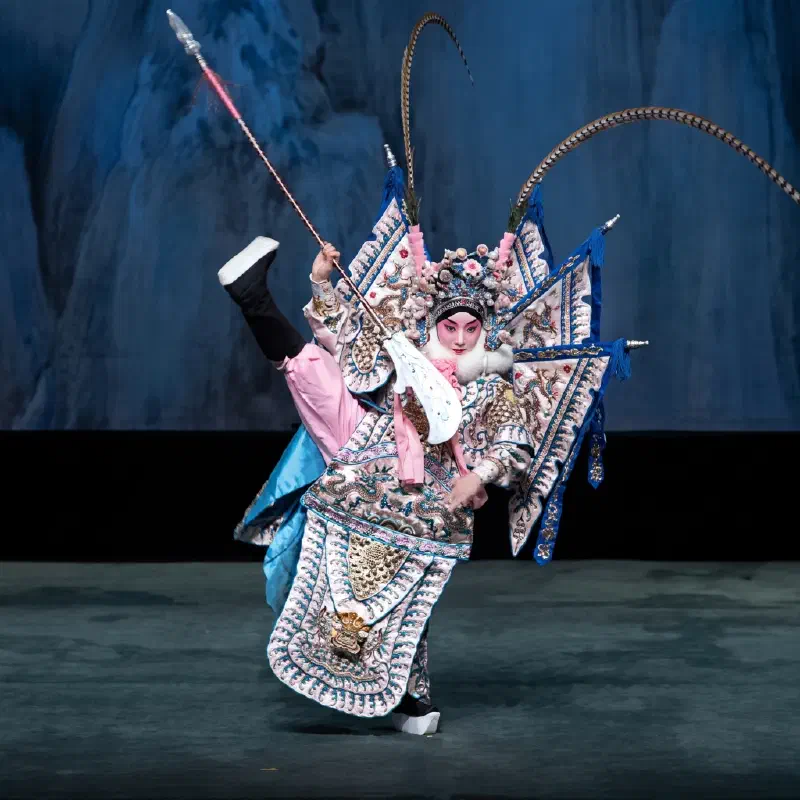
At its deepest core, the I Ching describes reality as a perpetual dance between two complementary and opposing forces: Yin and Yang. This duality is not static but flows in a continuous cycle of transformation. Peking Opera, far from being an exception, is entirely organized around this binary rhythm.
The spectacle is structured through the alternation of sequences of action and moments of stillness, of martial scenes (wu) and lyrical passages (wen). This pulsation is also manifested in the music, where thundering percussion (yang) contrasts with the sweetness of strings and wind instruments (yin). Even the actor’s breathing follows this pattern: inhalation is associated with Yang (expansion, strength) and exhalation with Yin (withdrawal, softness). Everything in Peking Opera is a reflection of this cosmic rhythm.
The Five Elements (Wu Xing): The Architecture of the Stage#
To fully understand the connection between Peking Opera and the I Ching, it is necessary to place the theory of the Five Elements (Wu Xing) in its historical and philosophical context.
The I Ching provides the fundamental principle: the idea that the universe is a harmonious system of forces in equilibrium, a cosmos governed by the flow of Yin and Yang. This conception laid the foundations for understanding art as a manifestation of universal order.
For its part, the theory of the Five Elements or Five Phases (Wu Xing) —Wood, Fire, Earth, Metal, and Water— developed as a parallel system in Chinese thought (Needham, 1956). Unlike the static elements of the Western tradition, the Wu Xing describes five phases of change in constant interaction, dynamic forces that generate and control each other in cycles of creation and domination (Liu, 2016). This system emerged to describe the qualities of energy in nature, medicine, politics, and the arts.
The decisive step occurred during the Han Dynasty (206 BC - 220 AD) , when both systems merged. It was during this period that scholars like Jing Fang (京房) integrated the theory of the Five Elements into the interpretation of the I Ching, creating a unified cosmology. This synthesis allowed for the establishment of systematic correspondences between the principles of the I Ching, the phases of the Wu Xing, and concrete phenomena such as music, colors, directions, and seasons.
Peking Opera adopts this conceptual architecture as a true “blueprint” for all its scenic elements. The influence of the I Ching, deepened by the theory of the Five Elements, is manifested in makeup, roles, and music, as we will see below.
Makeup and Costume: A Color Code#
Facial makeup (Lianpu) is one of the most distinctive features of Peking Opera. Far from being mere ornamentation, each color and pattern has a precise meaning that reveals the personality, social status, and even the destiny of the character. This chromatic code is directly inspired by the theory of the Five Elements (Huang, 2001). The symbolism of color in the costume and makeup of Peking Opera follows a codified code that has been studied in depth by Alexandra B. Bonds in her work Beijing Opera Costumes: The Visual Communication of Character and Culture (2008), where the correspondence between colors and the five elements (Wu Xing) is analyzed. The audience can distinguish a character’s personality by the dominant color of their makeup (Bonds, 2008).
- Red (Fire): Symbolizes loyalty, bravery, and righteousness. It is the color of heroes and loyal generals (Bonds, 2008).
- Black (Water): Represents integrity, impartiality, and brute strength. We see it in upright judges or rough warriors (Bonds, 2008).
- White (Metal): Is the color of treachery, cunning, and conspiracy. Worn by villains and corrupt courtiers (Bonds, 2008).
- Blue (related to Water): Symbolizes firmness, astuteness, courage, resolve, and an indomitable spirit. It is the color of rebel heroes and daring bandits (Bonds, 2008; Baidu Baike, 2026). The most representative example is Dou Erdun, the famous hero who stole the emperor’s horse, whose blue face and red beard are unmistakable (Bonds, 2008; Baidu Baike, 2026).
- Green (Wood): Indicates impulsiveness, violence, stubbornness, and lack of self-control. It is typical of explosive-tempered characters (ChinaEducationalTours, 2018).
- Yellow (Earth): Suggests ferocity, ambition, impetuousness, or, on occasion, cruelty (Bonds, 2008).
- Gold and Silver: Reserved for deities, immortals, and supernatural beings (Bonds, 2008).
Each Jing (painted face) character has a unique design, but always with a dominant color that defines their moral essence. The Baidu encyclopedia notes that blue, in particular, “represents characters who are firm, brave, and shrewd, often associated with rebel heroes and figures who oppose injustice” (Baidu Baike, 2026).
The Roles: From Five Traditional Roles to the Current Four Families#
Like the five elements, the characters of Peking Opera are divided into four major role families, each with its own vocal, gestural, and costume techniques (Chinaculture.org, 2014):
- Sheng (生): Male roles. Subdivided into laosheng (older or middle-aged men, with a false beard), xiaosheng (young men), and wusheng (acrobatic warriors).
- Dan (旦): Female roles. Include qingyi (mature, virtuous women), huadan (lively young girls), laodan (old women), and wudan (female warriors).
- Jing (净): Male roles of exaggerated character, recognizable by their colorful facial makeup with complex patterns (Lianpu).
- Chou (丑): Comic or secondary roles, easily identified by a white patch around the nose and eyes.
In ancient times, there was the Mo (末) role, which designated secondary or older male characters, and which over time was integrated into the Sheng category.
Music: The Pentatonic Scale and the Five Elements#
The music of Peking Opera, like much of traditional Chinese music, is based on the pentatonic scale, a system of five notes that is not an arbitrary choice but is directly inspired by the theory of the Five Elements (Needham, 1956).
Each of the five notes —宫 (Gōng) , 商 (Shāng) , 角 (Jué) , 徵 (Zhǐ) , and 羽 (Yǔ) — corresponds to an element and, therefore, to a specific quality:
| Note (Pinyin) | Note (Western) | Element | Quality |
|---|---|---|---|
| 宫 (Gōng) | Do | Earth | Central, stable, and nourishing note |
| 商 (Shāng) | Re | Metal | Clear, sharp, and decisive note |
| 角 (Jué) | Mi | Wood | Soft, ascending, and vital note |
| 徵 (Zhǐ) | Sol | Fire | Bright, expansive, and warm note |
| 羽 (Yǔ) | La | Water | Deep, fluid, and descending note |
This correspondence does not appear in the original text of the I Ching, but in the musical and cosmological theory developed after the Han fusion between the Wu Xing and the I Ching. It was then established that music, like all manifestations of the universe, must reflect the balance between the five cosmic forces. When we listen to the music of Peking Opera, we are not merely hearing melodies, but a sonic expression of that universal harmony.
The Art of Symbolism: Less is More#
The I Ching teaches that a handful of simple symbols—the trigrams—can represent the totality of the universe. Peking Opera applies this same logic masterfully.
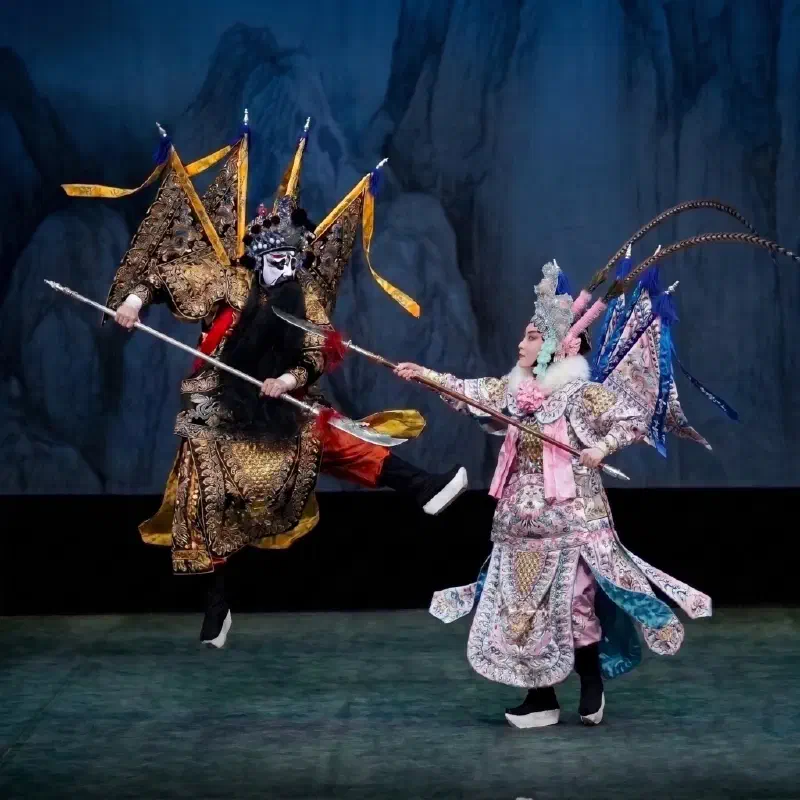
The stage is deliberately minimalist. A few soldiers symbolize an army of thousands. A whip with tassels indicates that the character is riding a horse. Two oars with tassels place us in a sailing scene. A black flag represents a hurricane wind, and one with waves, a flood (Siu & Lovrick, 2013). This use of props is not arbitrary but responds to a philosophical logic in which the meaning of the object is defined by the actor on stage, thus activating the “inherent meaning of the universe” (Daiyu & Amirul, 2025). Everything is stylized; everything suggests more than it shows. The active participation of the spectator’s imagination is necessary to complete the meaning of the performance.
This symbolism also extends to movement. Body language is highly codified. Opening a door, crossing a threshold, or climbing stairs are executed through conventional mimetic gestures. The hands and fingers are especially important; there is a specific language called “orchid language” (lanhua shou), where each position of the fingers evokes the petals of the flower and conveys a particular message (Timeout Hong Kong, 2022).
Even the names of the movements reveal this aspiration to embody the forces of nature: “Cloud Hand,” “Eagle Wing,” “Crane Step.” The actor does not imitate nature but embodies it, fusing the human with the cosmic in every gesture. Every movement and posture is carefully manipulated to avoid right angles and straight lines, privileging roundness as an aesthetic principle (Global Times, 2010), which is also one of the fundamental principles of Tai Ji Quan.
This symbolic logic extends to the representation of space and time. An actor walking in a circle on stage is not taking a stroll but making a journey of thousands of miles. A simple circular movement can transport the character from one city to another, condensing in seconds what in reality would be days of travel. It is the maximum expression of scenic suggestion.
To Western readers, it might seem paradoxical that, with the economy of scenic resources being one of the guiding principles of Jingju, movements in straight lines are proscribed, since, after all, the straight line is the shortest distance between two points (at least in Euclidean geometry). However, this is not entirely straight. The flight paths of airplanes, for example, are not linear but describe geodesic curves because they are more efficient. And we have the famous story of Johann Bernoulli’s challenge to the mathematicians of his time:
Given two points A and B in a vertical plane, what is the curve traced by a point acted upon solely by gravity, starting from A and reaching B in the shortest time?
The answer is not a straight line, as many might think, but a cycloid or brachistochrone curve. Thus, the roundness or circularity of movements in Chinese opera not only obeys an aesthetic principle but also, in a certain way, also obeys a principle of simplicity, efficiency, and parsimony.
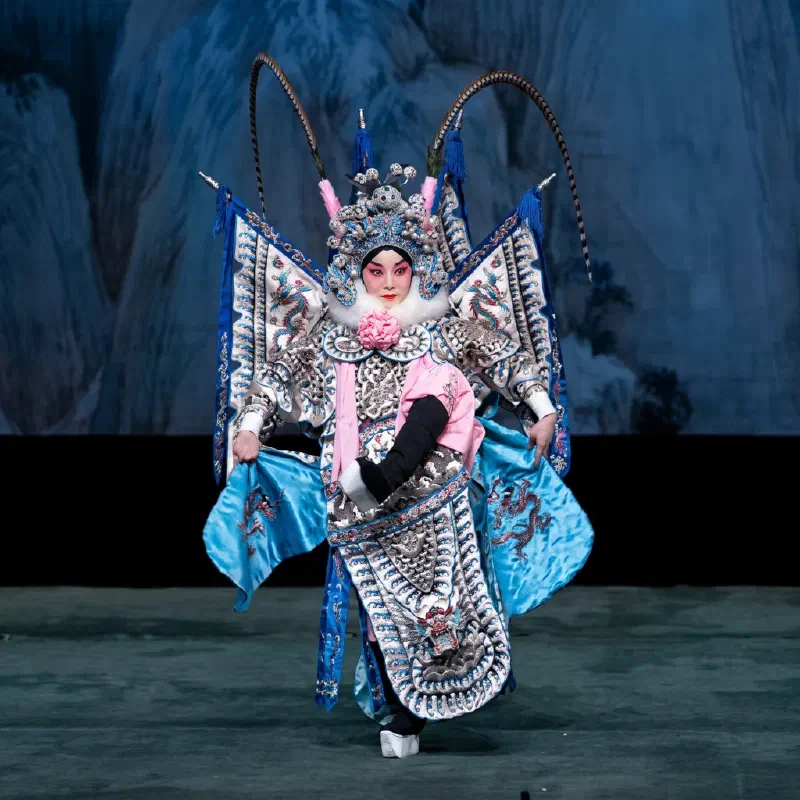
For a visual example of these principles, see the performance of Hou Dan Mei in the work The Fate of the Iron Bow, available on Arthur Banks’s channel (2022). This performance is the basis for some of the audiovisual material in the video on my channel that accompanies this article.
Conclusion: A Spiritual Heritage#
The connection between Peking Opera and the I Ching is not a direct or mechanical link. It is, rather, a spiritual heritage and a practical application of the same philosophical principles. The I Ching provided the conceptual language (Yin-Yang), the theory of the Five Elements provided the structural grammar (colors, roles, music), and Peking Opera transformed these abstract ideas into a living scenic art.
When witnessing a Peking Opera performance, we are not simply seeing a play. We are witnessing a philosophy in motion, a cosmology represented through song, gesture, and color, where every element—no matter how small—resonates with the order of the universe (UNESCO, 2010). That is, perhaps, its greatest greatness and its deepest link with the Book of Changes.
For an audiovisual exploration of these concepts, I recommend the video accompanying this article on my YouTube channel.
References#
Baidu Baike. (2026). 蓝脸 [Blue face]. Retrieved from https://baike.baidu.com/item/%E8%93%9D%E8%84%B8/11045146
Banks, A. [@arthurbanks7766]. (2022, March 15). English Subtitles, Peking Opera Marriage Fate of the Iron Bow 铁弓缘HOU Dan-Mei [Video]. YouTube. https://www.youtube.com/watch?v=ZW3mKpFEoA0
Bonds, A. B. (2008). Beijing opera costumes: The visual communication of character and culture. University of Hawai‘i Press.
ChinaEducationalTours. (2018). Peking Opera: Makeup, Staging, Music and Costumes. Retrieved from https://www.chinaeducationaltours.com/guide/culture-peking-opera-staging-music-costumes.htm
Chinaculture.org. (2014, December 3). Peking Opera roles of sheng, dan, jing and chou. http://en.chinaculture.org/focus/2014-12/03/content_580124.htm
Daiyu, D., & Amirul, A. A. (2025). A Taoist interpretation: Qiemo (stage props) produced Peking Opera space. Harmonia: Journal of Arts Research and Education, 25(1), 59-71. https://doi.org/10.15294/harmonia.v25i1.10441
Global Times. (2010, August 27). Visual and aural performance elements of Beijing opera. https://www.globaltimes.cn/content/567952.shtml
Huang, J. (2001). Art of Chinese Opera Masks. Shanghai People’s Fine Arts Publishing House.
Legge, J. (1996). The I Ching: The Book of Changes (2nd ed.). Dover Publications. (Original work published 1882)
Liu, M. (2016). Wuxing and Yinyang. In The Routledge Handbook of Chinese Medicine. Routledge.
Needham, J. (1956). Science and Civilisation in China (Vol. 2, History of Scientific Thought). Cambridge University Press.
Siu, W.-N., & Lovrick, P. (2013). Chinese opera: The actor’s craft. Hong Kong University Press.
Timeout Hong Kong. (2022, October 24). A look into Chinese opera, one of the oldest dramatic arts in the world. Retrieved from https://www.timeout.com/hong-kong/art/a-look-into-chinese-opera-one-of-the-oldest-dramatic-arts-in-the-world
UNESCO. (2010). La ópera de Pekín. Representative List of the Intangible Cultural Heritage of Humanity. Retrieved from https://ich.unesco.org