What is the universe?#
The most fundamental question of humanity has never changed:
“What is the universe?”
In the ancient world, the I Ching (易經) answered: The universe is change (變).
Knock your knuckles on the wooden table right in front of you. You perceive a solid, dense, and completely real surface. Now imagine you are exploring an open‑world video game.
The mountains on the screen look huge and textured, but we know perfectly well that they are not real physical objects we can touch. Beneath those beautiful digital sunsets, everything boils down to information. Sequences of zeros and ones interacting at astonishing speed.
What we see as solid physical objects behaves more like running software, constantly updating the position of every atom. To understand how this mechanism works, we will combine a 3,000‑year‑old text, the rules of quantum physics, and the latest concepts in artificial intelligence.
Reader warning: when we say that the I Ching ’encodes’ space or time, we are not claiming that its authors knew relativity or computer science. We are doing what good translators do: pouring an ancient language (that of changes and polarities) into today’s language (that of bits and quantum states). In this article we explore how, despite the profound differences between eras and languages, the I Ching, mathematics, 20th‑century computing, and quantum physics have converged on a remarkably similar vision.
The cosmogony of the I Ching#
Long before computers existed, ancient scholars in China produced a text called the I Ching. They concluded that the material world is not simply made of solid things, as Parmenides and Democritus held, but of an incessant flow of transformations, as Heraclitus postulated.
To explain this, they began with an indivisible state and split it into two opposite values, yin and yang – a choice between two options. This diagram shows how the two initial options multiply.
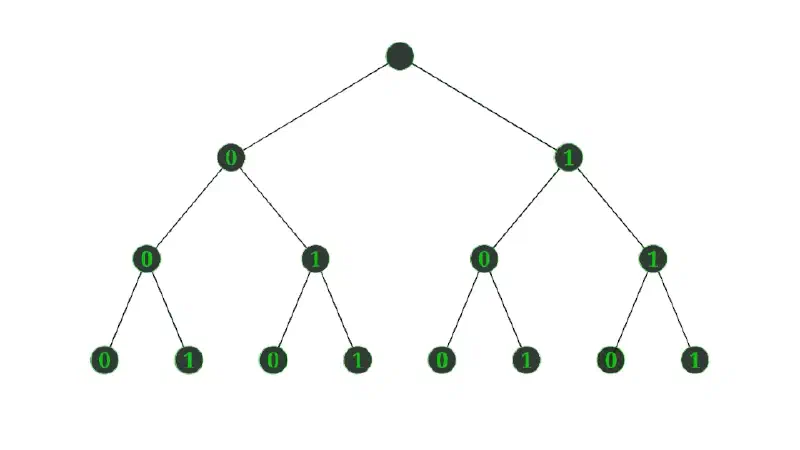
Two become four, four become eight, … and so on, until exhausting all the multiplicity of possible things on earth, as stated in Chapter IX of the Great Treatise (Ta Chuan), one of the famous “Ten Wings” or appendices of the I Ching:
The eight signs form a small consummation. If one continues and advances and augments the circumstances through the transitions to the corresponding others, all possible situations on earth are thereby exhausted.
The representation of change (time) in the I Ching#
If the individual yin or yang lines are bits (binary digits), let us now outline a semantic data architecture for the various sequences of n bits. Basically, we intend to perform reverse engineering to extract the source code or the “algebraic system” of the I Ching, assigning to each bit the exact function it fulfills within the algorithm of reality.
With \(n=2\) (two lines), we have the bigrams. One bit encodes the basic polarity (yin or yang), and the other bit is a logical operator of mutability. In the language of the I Ching, these bigrams are known as the four images:
- ⚏ is the Old or Great Yin
- ⚎ is the Young or Small Yin
- ⚍ is the Young or Small Yang
- ⚌ is the Old or Great Yang
These four images (bigrams) are the basic component of the I Ching in its oracular application. The four images thus give us the basic algorithm of change. They introduce the temporal component into our representation system and encode the fundamental principle of the I Ching regarding “extremes leading to reversal” – Wù jí bì fǎn (物极必反).
The representation of space and the fundamental forces of the universe – the trigrams#
By adding one more bit and recursively expanding the binary tree, we have \(2^3=8\) states, which give us the 8 trigrams:
| ☰ Qián | ☷ Kūn | ☳ Zhèn | ☲ Lí |
|---|---|---|---|
| ☱ Duì | ☴ Xùn | ☵ Kǎn | ☶ Gèn |
However, by adding this third bit, the I Ching makes a monumental semiotic leap. With 2 bits we have encoded time (the four seasons, or the cycle of birth and maturation of polarity). By adding the third bit, the system moves on to model space and function, creating “representative images of real universal states or situations”.
Thus, while the 3 lines of a trigram still have a polarity, the meaning of these three lines no longer represents polarity per se and its mutability (time), but acquires a specific ontological meaning called the “three primordial potencies”. The I Ching defines the meaning of each bit position as follows:
- Lower bit (bottom line): Represents Earth. It is the object that has form, the material and physical basis of the situation.
- Middle bit (middle line): Represents Man (the subject). It is the conscious center that experiences and mediates reality.
- Upper bit (top line): Represents Heaven. It is the content, the spiritual or cosmic law that governs the situation from above.
According to the Yin/Yang polarity of each primordial potency, each hexagram has particular qualities that explain the names given to them: Heaven, Earth, Mountain, Lake, Water, Fire, Wood, Thunder. The trigrams represent fundamental processes or energies of the Universe according to I Ching cosmogony, but they do not incorporate the temporal parameter.
Encoding the state space of the Universe at three levels of resolution#
With n=6 we have the hexagrams of 6 lines, which, as we already know, represent the 64 archetypal situations in which the I Ching describes the state of reality at a given moment. There are three distinct and simultaneous levels of resolution.
On the one hand, we divide a hexagram into two trigrams, one lower and one upper. The lower trigram is formed by lines 1, 2 and 3, and the upper hexagram by lines 4, 5 and 6. This is the local level, in which the lower trigram, also called the “inner sign”, represents the internal world, the subjective, the domestic, or the space where the individual prepares. The upper trigram, or “outer sign”, represents the external world, the objective, the public, or the macrocosmic manifestation of the situation.
On the other hand, we can consider the global level in which the 6 lines (bits) of the hexagram are taken as a whole. The Great Treatise explains that the sages “joined these three fundamental energies and doubled them”. Now having 6 positions (memory spaces) to distribute 3 potencies, the algorithm assigns a pair of bits to each potency (an odd/Yang position and an even/Yin position).
Under this global mapping across the entire 6‑bit matrix, the two lower positions (1 and 2) constitute the place of Earth, the two central positions (3 and 4) constitute the place of Man, and the two upper positions (5 and 6) constitute the place of Heaven.
There is yet another level of resolution or representation, which we will call the six stages of becoming. Under this level, we reintroduce the temporal parameter into the system, and the 6 lines come to represent the evolution of a state, from line 1, where the action only begins its unfolding (it has not really started), to line 6, where the action has reached its end and is contemplated from the outside.
The three levels of resolution in the text of the I Ching#
These three levels of resolution are found in the texts for each hexagram in the I Ching. The local level, for example, exists as the Image of the hexagram. The Treatise (Ta Chuan) explicitly states that the Commentary on the Images “refers to the images of the two half‑signs (trigrams), deriving from them the meaning of the integral sign”. It is the intersection of natural forces. To use a computational metaphor, it is the topology of the network: How do the internal module (front‑end) and the external (back‑end) communicate?
The global level corresponds to the Judgment or Decision of the hexagram. “The Decisions (Sentences) given by King Wen for the total signs refer in each case to the Image represented by the total situation.” It is the evaluation of the matrix as a unified whole. Computationally speaking, it is the general diagnosis of the system: Is the current state of the matrix favourable, or does it throw an error?
Finally, the six stages of becoming correspond to the section of the moving or individual lines, which provide additional sentences for alterations (mutations) in any of the stages of the process. It is the debugger reading the code line by line in real time. It tells us at which exact points of the temporal process (from bit 1 to bit 6) a “mutation” or modification is occurring, and provides us with a correction code (parity bit or error‑correcting code).
What is the Universe made of?#
It is worth pausing here. When we speak of ‘code’, ‘bits’ or ‘physical laws’, we are not describing the ultimate substance of the universe, but the languages we have invented to approximate its behaviour. Quantum physics is not reality; it is a mathematical model that holds as long as it is not falsified by a new experiment. The I Ching is not reality; it is a symbolic model that holds as long as its patterns continue to resonate with human experience. What this article proposes is not that one of these models is ’true’ and the other ‘metaphorical’, but that both, from different shores, are tracing the same coastline: a universe that updates itself at every instant.
From the fundamental opposite values – yin and yang – or zero and one, to use modern computer terminology, we can create entire worlds and universes, as in today’s video games. The authors of the I Ching had already anticipated this idea centuries earlier. So, is the universe made of tiny material particles, as Democritus proposed?
After many experiments with particle colliders to search for the smallest piece of matter, physicists concluded that it is not. They never found a solid, permanent sphere at the core of the universe. Instead, they detected invisible energy fields.
Every material object we perceive with our senses is actually a temporary fluctuation within these interactive fields. Theoretical physicists like Carlo Rovelli propose that space itself lacks a smooth mathematical continuity; it is rather an intrinsically discrete structure. At the quantum scale, the fabric of reality reveals itself as a finite state space, just like the set of the 64 hexagrams of the I Ching.
Think of this as the graphics engine of a video game console. The physical world draws visible matter only when those particles interact with each other. Modern physics provides us with a rigorous mathematical elaboration of the intuitions of ancient texts.
The Universe as running software#
The universe operates as a continuous computational process. If the universe is code and data processed according to the laws of physics, an immediate question arises: Who is the player looking at the screen? This brings us to inventors like Ray Kurzweil, who investigate the exact intersection between human biology and artificial intelligence.
Kurzweil maintains that your mind is not a rigid anatomical object. Your memories and personality form an ever‑changing pattern of information. You are, at a technical level, running software. But where Kurzweil holds that everything is computable – even from the mathematics of the 20th century – thinkers like Gödel and Turing showed that in any logical system there will always be truths that cannot be proven:
- Gödel’s Incompleteness Theorem: In any sufficiently complex logical system, there will exist “truths” that cannot be proven within that very system.
- Turing’s Halting Problem: There is no general algorithm that can determine in all cases whether a program will halt or continue running indefinitely.
The Universe is made of … Consciousness#
An infinite amount of computation can never equal the feeling of human affection, or the aroma of coffee in the morning. Contemporary thinkers like David Chalmers call this frontier the hard problem of consciousness. In the language of the Tao Te Ching:
The Tao that can be expressed in words is not the eternal Tao. The name that can be uttered is not the eternal name.
This concept aligns precisely with other philosophical currents of the East, such as Buddhism, where the self is never defined as something rigid and static, but as a temporal process that updates itself.
Orthodox quantum mechanics defines the ‘observer’ as a measuring apparatus. However, there are heterodox interpretations, such as Roger Penrose’s, which propose that consciousness could be linked to wave‑function collapse processes. Although this theory (Orch‑OR) lacks experimental consensus and is criticised for issues like decoherence, its very existence shows that the boundary between physics and philosophy of mind remains open.
Keeping this openness of perspective, we could affirm that the human being is not a passive spectator located outside the universe observing it from a distance. Their mind is part of that same code. It is the universe processing itself.
Reality then operates on two simultaneous layers. The universe generates billions of data per second, but it is consciousness that gives it meaning. And you, who are reading this, are the spark that turns calculations into living reality.
Complement the reading with the video:#
If you prefer to deepen these concepts visually and hear a detailed analysis, I invite you to watch the video on my channel: