My project El I Chingón is the marriage of two worlds that are antipodal to one another: an oracle whose origins are lost in the mists of time, and the modern digital world, with Artificial Intelligence automating everything in its path. The fruit of that marriage is a consultation app that aims to make the millennia-old wisdom of the I Ching accessible to everyone.
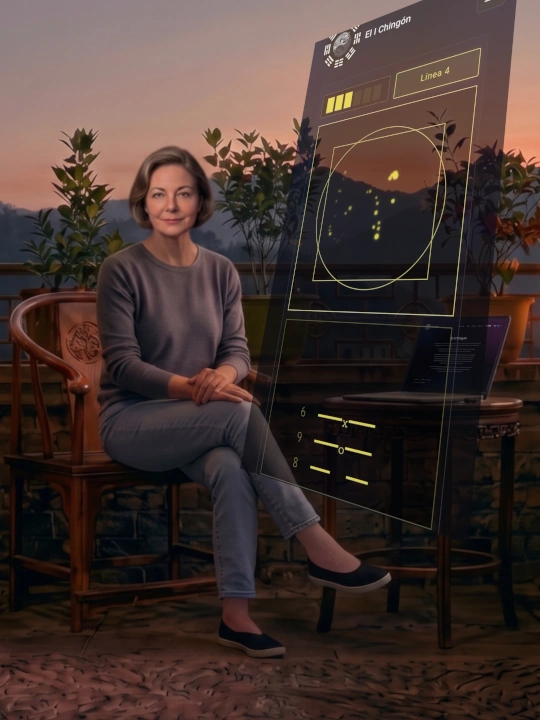
But in all honesty, I want to put before you a dilemma that has always been on my mind during the development process of this app: If I isolate the essential elements of the I Ching, could we do without a consultation ritual? Or, on the contrary, is the I Ching something “spiritual” that can never be encoded in an algorithm, but rather requires a “magical ritual”?
The answer to this is not—as a famous politician of my country used to say—neither one thing nor the other, but quite the opposite.
And the answer to that question necessarily passes through this other one:
What makes a consultation of the I Ching truly meaningful and valid?
In our digital age, it is easy to assume that the effectiveness of a modern oracle such as my app aspires to be rests on the precision of its code or the sophistication of its algorithm (that is, on the decisions I make as the app’s developer). However, as we will see in this article, the clarity of this digital oracle’s answers does not depend solely on how good my software is, but on the inner state of the querent at the precise moment of formulating the question.
These insights are the fruit of joining the messages of two consultations of the I Ching made at different times: one about the mental disposition required to approach the oracle, which yielded Hexagram 33 (Retreat), and a more recent one about the technical requirements of our application, which answered with Hexagram 25 (Innocence). Both answers, seemingly distant, converge on one and the same truth.
The first step: Silencing the noise (Retreat)#
The process begins long before casting the coins or tracing lines on a screen. It begins with a question. And it continues with a reflection on that question: Why do I really want to know this? What are the assumptions behind my question?
Ritual preparation requires, first of all, formulating our question clearly, avoiding dichotomous questions (of the yes/no type) in order to invite a descriptive answer that reflects the holistic interaction of Yin and Yang. And since the I Ching is above all a tool for self-knowledge, it is advisable to clarify to ourselves what attitudes, emotions, and sensations we bring with us or assume others bring in the context of the question.
It is advisable—and this is important to point out—to write the question down. Not only because when you write you clarify your thoughts further, but because at the moment of interpreting the oracle, the question gives us an indispensable framework for its interpretation, whether you turn to an interpreter of the I Ching—human or AI—or interpret the answer yourself.
But having the question is not everything. There is, after all, a preparation ritual. On one occasion, I asked the I Ching this:
What, according to the I Ching itself, should someone who consults the I Ching seeking wisdom or a deep perspective on a crossroads or complex situation keep in mind?
And the I Ching answered me with Hexagram 33, Retreat, with moving lines 4, 5, and 6, whose image presents heaven above the mountain. The querent should be like that mountain, remaining firm and in sublime stillness, without trying to access spiritual knowledge by force.

But what should we retreat from? It is not a physical retreat, but rather distancing ourselves from the lower aspects of ourselves: the incessant mental chatter, the ego’s preconceptions, the sense of urgency, and the pursuit of immediate or magical results. Creating this space of inner silence is the fundamental requirement for the oracle to speak to us clearly.
The inner summit: The ascent toward Modesty#
The image of the mountain beneath heaven resonates deeply in the human spirit as a universal archetype. From Sinai and Golgotha in the Judeo-Christian tradition, through the Greek Olympus and Mount Kailash in India, to the misty mountains of Penglai in China, summits have always represented the threshold where earth and heaven meet.
This symbolism is masterfully captured in the novel Mount Analogue by the surrealist poet René Daumal, where a mountain is described whose base is accessible to anyone—like everyday life—but whose summit is invisible unless the seeker is on the correct spiritual frequency. The I Ching works in exactly the same way: its base (the text and the method) is there for everyone, but its true wisdom is revealed only to those who adopt the right attitude when beginning the ascent.
The moving lines (4, 5, and 6) of Hexagram 33 show us the rungs of this ascent, indicating that the consultation must be a voluntary decision in which one lets go of unnecessary burdens, maintaining a serene attitude that culminates in liberation from the need to control the outcome—a state where “everything is favorable.” This process transforms Hexagram 33 into Hexagram 15, Modesty, revealing that the success of the retreat leads to a state of equanimity and balance. As other sacred traditions teach, humility—emptying oneself of one’s own expectations—is the master key to receiving grace or wisdom.
The digital mirror: Innocence before the algorithm#
If Retreat and Modesty metaphorically describe the ideal inner terrain of the querent, what happens when the consultation tool is an interactive web application? Recently, I brought this concern to the I Ching itself, asking whether the system I developed—which captures the entropy of the user’s strokes on a canvas to generate the hexagram—meets the technical requirements and respects the principles of the oracle.
The question, specifically, was this:
I have developed an I Ching consultation application that uses the user’s strokes on a canvas to generate entropy and thereby obtain the resulting hexagram (and moving lines) of their consultation, which is then interpreted by an LLM (AI). Are these I Ching readings valid? Do they respect the functional principles of the oracle?
The answer was Hexagram 25, Innocence, with the first moving line, mutating into Hexagram 12, Standstill.
As often happens with the I Ching’s answers, there are several possible readings here. One possibility is suggested by the text of the first moving line:
At the beginning a Nine means: An innocent course of action brings good fortune! The first original impulses of the heart are always good, so one may follow them with complete confidence, certain that one will find happiness and achieve one’s aims.
Then, with reference to me, the one who asked the question, it could be a questioning of my original intentions when I created the application: Was it a genuine impulse to share the I Ching? Or is there a hidden desire to profit from a situation or to seek validation?
But a little reflection leads us to another possible interpretation of this moving line. That the first original impulses of the heart are always good also leads us to think about the querent’s question itself and about honestly clarifying what one’s motives are. The innocence of Hexagram 25 does not point to naivety, but quite the opposite: to the purity of honesty with which one approaches the oracle itself.

The message then takes shape with greater force: the validity of a consultation through my app does not reside in the technical sophistication of the algorithm that processes the strokes, but in the honesty and spontaneity of the moment of consultation. The system attempts to capture a free gesture, but if the user approaches the canvas with the hidden intention of subtly manipulating the result, or with the expectation of forcing a specific answer, the reading loses its root.
Hexagram 25 reminds me of a very popular phrase in my country when it comes to choosing a random number for a raffle: “May an innocent hand come and draw the number.” The hand of the user who uses my application must be that innocent hand. Their stroke must be free of hidden agendas, while remembering that innocence is not naivety and that one’s attention must be focused entirely on the question, and never on the answers we hope to obtain (because we must expect nothing). If there is a divorce between the intention to control the tool and the necessary surrender to the mystery, the inevitable result will be standstill (Hexagram 12), in which Heaven and Earth do not communicate and the querent will receive no wisdom from the oracle.
The necessary friction: The sacrifice of ritual and design#
This revelation confronted me with a profound paradox as a developer. The primordial instinct when designing a user interface (UI) is to eliminate all friction and make life easier for the visitor. However, consulting the I Ching is a ritual, and like every ritual, it demands a sacrifice.
As a result of this reading, I decided to implement improvements in our platform’s interface to emphasize certain uncomfortable truths as reminders to the user: the oracle does not return pre-digested answers and does not predict the future in a fatalistic way. Above all, it underscores that the heavy responsibility of interpreting and assimilating the wisdom falls entirely on the user, and not on the AI, which merely translates the archaic language of the I Ching texts into a language comprehensible to our times.
There are things that technology should not facilitate excessively. We can automate the generation of PDF reports and the collection of entropy, but we cannot automate introspection. As the famous saying goes: you can lead a horse to water, but you cannot make it drink. If the querent is not willing to make the mental and emotional sacrifice that hermeneutics demands, they will obtain nothing of value.
The I Ching itself warns of this in the judgment of Hexagram 4 (Youthful Folly): “It is not I who seek the young fool; the young fool seeks me.” If you seek absolute, easy answers served up on a silver platter, this oracle is simply not for you.
Conclusion: The perfect system requires an “empty” user#
With modern technology one can build the perfect digital Mount Analogue (or perhaps the Analogue-Digital Mount?), with a base accessible to anyone with a device and an internet connection, providing an impeccable canvas and a rigorous mathematical algorithm. But the oracle is, ultimately, an implacable mirror of the mind.
Regardless of whether you use yarrow stalks, bronze coins, or an interactive canvas on a screen, the system is worth nothing if attention and intention are not in the right place. It requires the stillness of Retreat, the receptivity of Modesty, and the purity of Innocence. Only when the user presents themselves “empty” before the oracle does true wisdom find the space to manifest.
Complement the reading with the video:#
If you prefer to delve into these concepts visually, I invite you to watch the following videos on my channel:
You can review the interpretation report generated by my I Ching consultation app here.