
Abstract. We propose a decentralized, non-deterministic decision-making framework - Constrained Stochastic Hermeneutical Computing (CSHC) - that resolves the inherent sycophancy of commercial Large Language Models (LLMs) and the deterministic limitations of pseudo-random number generation. By utilizing Kinesthetic Entropy Capture (KEC) to harness physical human movement, the system establishes a hardware-level filter against cognitive bias and ego projection. This raw entropy is processed through a finite-state reasoning engine based on the I Ching, mapping the data onto a 4,096-state semantic vector space to compute structural causality. Finally, an edge-computed, strictly constrained LLM acts as a neutral hermeneutic translator, bridging the algorithmic output with the user’s context. The result is a mathematically rigorous, privacy-first protocol that processes physical chaos into actionable insight without centralized data extraction or AI adulation.
The Reasoning Engine: Overview of the I Ching as a divination tool#
The I Ching is both a divination tool and a book of wisdom, dating back thousands of years. Like all oracles, it is based on a random experiment (grouping yarrow stalks or tossing three coins six times), to obtain a cast hexagram, or symbol composed of 6 lines that can be either Yin or Yang, or Yin that mutates to Yang, or Yang that mutates to Yin. There are in all 64 possible hexagrams (2⁶). Each hexagram corresponds to an archetype or symbol that “maps” on to the consultant’s question to the oracle in a meaningful way.
Furthermore, any given line can be a mutating Yin or Yang line, and mutating lines, if there are any, also indicate that the present situation the seeker is asking about is evolving, how it is evolving and what advice is given to navigate the situation successfully. In the presence of moving lines, the cast hexagram is evolving into a secondary hexagram that gives us an indication of the probable future the situation is evolving into were we to follow the advice of the moving lines or conversely, the future we would be avoiding by acting in accordance with the oracle’s advice.
Hexagram Castings as elements of a Semantic Space#
The I Ching constructs its profound wisdom from a remarkably simple binary foundation of Yang and Yin, which form the basic code for a far more complex semantic architecture. This structure is computationally elegant; each ritual casting selects one point from a discrete vector space of 4,096 unique states (4⁶), accounting for stable and transforming lines. This number is pivotal: it provides a parsimonious yet sufficiently vast model to map the myriad situations of human experience, offering immense explanatory power while keeping interpretation tractable.
This tractability arises from the system’s layered grammar, where meaning is bounded and contextualized at each level. The specific meaning of a line is not free-floating but is shaped by its position - from the foundational first line to the culminating sixth - and by the trigram it helps form, allowing a core set of interpretations to be adaptively applied across different contexts. This precise, rule-based structure is what enables consistent navigation of its symbolic depth.
The 64 hexagrams represent (ambivalently) different processes in the universe in different context layers, and the presence of moving lines in a cast hexagram provides specific points of attention within that process. In the presence of moving lines, the consultant obtains a “future” or derived hexagram, which should not be interpreted as a divination or glimpse into the future, but rather, as a structural consequence of that particular process indicated by the cast hexagram and its dynamics of change. This is worth noting- the I Ching does not predict the future in the divinatory or mystical sense, but rather in the same way that scientific theories predict the future- as the most likely outcome of the system’s state and the dynamic model’s structural equations.
The semantic depth of an I Ching consultation is further unlocked through the hexagram’s inherent dimensions of transformation. The core of any situation is revealed by its nuclear trigrams, formed from the inner lines, which expose the hidden dynamic at the heart of the cast symbol. Furthermore, and this point is relevant to my consultation app, by referencing the pre-heaven sequence - the ancient arrangement of hexagrams that maps the order of cosmic principles - one can trace the cast hexagram back to its antecedent “world of thought.” This reveals the foundational conditions and patterns of causality that gave rise to the present moment, offering unparalleled insight into its genesis.
In short, the I Ching operates as a sophisticated ontological computer. Its 64-archetype matrix, expanded through rules of change and relational layers, forms a complete state-space for modeling reality. By identifying one’s coordinates within this 4,096-state field and analyzing the trajectories revealed by its nuclear and antecedent hexagrams, it provides a precise algorithm for harmonizing action with the universe’s fundamental patterns. This precise, computable grammar of change, which explains both the present state and its causal substrate, is what makes it an exceptionally potent framework for guiding complex decision-making and the reason why the I Ching is at the core of our app’s Reasoning Engine.
The Synchronicity Engine: Kinesthetic Entropy Capture (KEC)#
KEC ensures that the user participates in obtaining the resulting hexagram and that chance incorporates the user’s movements or gestures, which is an exact reflection of physically tossing coins: what we call the consultant’s energy or vibration, contained in their subconscious but completely ignored or made explicit to the world, travels through their gestures and movements.
KEC acts as a first line of defense against the ego and its own ghosts or projections, which recalls an old Zen story:
The Ghost
The wife of a man became very sick. On her deathbed, she said to him, “I love you so much! I don’t want to leave you, and I don’t want you to betray me. Promise that you will not see any other women once I die, or I will come back to haunt you.” For several months after her death, the husband did avoid other women, but then he met someone and fell in love. On the night that they were engaged to be married, the ghost of his former wife appeared to him. She blamed him for not keeping the promise, and every night thereafter she returned to taunt him. The ghost would remind him of everything that transpired between him and his fiancee that day, even to the point of repeating, word for word, their conversations. It upset him so badly that he couldn’t sleep at all. Desperate, he sought the advice of a Zen master who lived near the village.
“This is a very clever ghost,” the master said upon hearing the man’s story. “It is!” replied the man. “She remembers every detail of what I say and do. It knows everything!” The master smiled, “You should admire such a ghost, but I will tell you what to do the next time you see it.” That night the ghost returned. The man responded just as the master had advised. “You are such a wise ghost,” the man said, “You know that I can hide nothing from you. If you can answer me one question, I will break off the engagement and remain single for the rest of my life.” “Ask your question,” the ghost replied. The man scooped up a handful of beans from a large bag on the floor, “Tell me exactly how many beans there are in my hand.”
At that moment the ghost disappeared and never returned.
This is why most oracles, regardless of tradition, incorporate chance: because what lies outside the ego’s context window cannot be amplified or projected onto the answer. This is why we use a kinesthetic entropy capture.
Operational definition of KEC#
Technically, this works as follows: the user is presented with a minimalist UI (user interface) containing a canvas with a square and a circle inscribed within one another (the squaring of the circle). This figure is not decorative: it condenses the tension between the deterministic and the transcendental that runs through the entire consultation, and whose symbolic and philosophical foundation we develop at the end of this section.
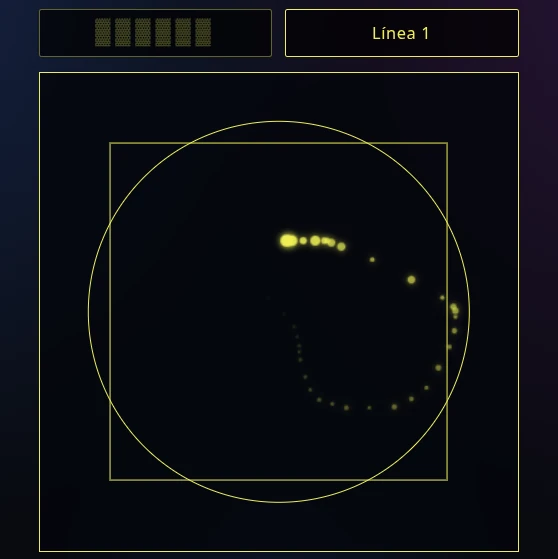
On this canvas, the user makes strokes with the mouse pointer or finger on their device’s touchscreen, capturing tuples (x,y,t) corresponding to points on the canvas and the moment in which they are generated.
The hash algorithm and the transcendental nature of the consultation#
KEC does not merely capture the user’s movement: it transforms it, together with the entropy of the moment and the environment, into a discrete value corresponding to a line of the hexagram. This transformation is carried out using a non-cryptographic hash algorithm, 32-bit FNV-1a, whose choice is not arbitrary: it reflects, on the technical plane, the same impossibility of deterministic reduction that the squaring of the circle represents on the geometric plane.
The FNV-1a algorithm#
FNV-1a (Fowler–Noll–Vo, variant 1a) is a hash function defined by the following recurrence:
h₀ = offset_basis
for each character c in the input:
hᵢ₊₁ = (hᵢ XOR c) × prime (mod 2³²)
For 32 bits, the standard constants are:
| Constant | Hexadecimal value | Decimal value |
|---|---|---|
| Offset basis | 0x811c9dc5 | 2,166,136,261 |
| FNV prime | 0x01000193 | 16,777,619 |
The offset basis is a non-zero initial value, chosen in its origin almost anecdotally (a mis-copied email signature), but whose function is to ensure that the empty input does not produce a trivial hash. The FNV prime, on the other hand, was selected through precise mathematical criteria: it must have few bits set to 1 (exactly six in its binary representation), a specific form \(2^{24} + 2^8 + 0x93\), and modular properties that maximize bit dispersion. These criteria ensure that the multiplication does not concentrate entropy in a reduced subset of bits, but distributes it uniformly across the 32 bits of the accumulator.
In code, the implementation is direct:
let h = 0x811c9dc5;
for (let i = 0; i < rawData.length; i++) {
  h ^= rawData.charCodeAt(i);
  h = Math.imul(h, 0x01000193);
}
Math.imul guarantees 32-bit arithmetic with controlled overflow, avoiding the precision loss that would occur with JavaScript’s * operator for products exceeding \(2^{53}\). The final result is a 32-bit unsigned integer, which is subsequently normalized to a float in \([0,1)\) through an additional mix with Math.random().
The avalanche effect: non-linearity under minimal variations#
KEC’s fundamental requirement is that a minimal variation in the user’s movement — a one-pixel difference in x, a one-millisecond difference in t — produces a qualitatively distinct hash, not a proportional variation. This is the avalanche effect, formalized by Shannon: a one-bit change in the input should change, on average, half the bits of the output.
Consider two pools differing in a single tuple, in a single pixel:
Pool B: 123,45,1023;125,46,1031;...The serialized string differs in a single character: '4' → '5'. In the FNV-1a loop, up to the position of the modified character, the accumulator h is identical in both cases. At that position, the XOR produces a one-bit difference. The multiplication by the prime amplifies that difference: a change of 1 in h produces a change of approximately p in the product, which modulo \(2^{32}\) spreads across many bits. Subsequent iterations continue amplifying the divergence, because each XOR and each multiplication operate on already different states. After a few iterations, the two hashes are completely distinct, with no apparent relationship.
Non-linearity comes from two sources. First, XOR is linear over GF(2) bit by bit, but multiplication introduces carries, which are non-linear operations on the bits. The combination XOR → multiplication breaks any linearity the XOR might have had. Second, the position of the change matters: a change in character i affects hᵢ, which then goes through (n - i) additional iterations. The earlier the change occurs, the more iterations amplify it; the later, the fewer. But even a change in the last character produces a significant difference, because the final XOR alters h before the last multiplication.
FNV-1a is not cryptographic: its avalanche is good in practice, but not optimal. The high bits are less mixed, and collisions are known for the 32-bit version. For the purpose of the I Ching, these limitations are irrelevant: neither collision resistance nor cryptographic uniformity is required. What is required is that minimal variations produce distinct results, and that is met with room to spare. The deviation from the ideal 50% is small and does not affect practical use.
The conjunction of entropies: kinesthetic, temporal, and environmental#
The string that is hashed combines three sources:
| Source | Origin | Nature | Typical length |
|---|---|---|---|
Tuples (x, y, t) | User’s movement | Kinesthetic | Hundreds–thousands of characters |
Date.now() | Moment of the consultation | Temporal | ~13 characters |
Math.random() | System chance | Environmental | ~18 characters |
In length, the tuples clearly dominate. In effect on the hash, there is no linear relationship between length and contribution: each character contributes to the result, but the effect of a character depends on its position and the accumulated state. If the pool is short (20 tuples, ~200 characters), Date.now() and Math.random() represent ~15% of the string, and their contribution is proportionally significant. If the pool is long (1000 tuples, ~10,000 characters), they represent ~0.3%, but their contribution is not null: a change in the last character of the string still alters the hash significantly, because the last multiplication propagates that change.
There is therefore no absolute preponderance of one source over another. Kinesthetic entropy dominates in volume, but environmental entropy always contributes to the final result, regardless of pool size. This guarantees that each consultation is unique, but also that kinesthetic entropy is not lost: it remains the majority component of the string.
Coherence with the I Ching tradition#
In the I Ching tradition, consultation is not an act of “pure intention” nor of “pure chance.” It is a conjunction. In the 50-yarrow-stalks method, the consultant contributes their movement when dividing the piles; the moment contributes the “here and now”; the environment contributes the resistance of the stalks, the humidity, the surface. In the 3-coin method, the consultant contributes the force and direction of the toss; the moment contributes the instant; the environment contributes the air, the surface, the spin. In both cases, the result is neither “purely kinesthetic” nor “purely random”: it is a mixture.
The correspondence with KEC is structural, not analogical:
| Tradition | KEC |
|---|---|
| Hand movement | Stroke (x, y, t) |
| Moment of the toss | Date.now() |
| Air, surface, jitter | Math.random() |
| Division/calculation | FNV-1a + mapping to 6/7/8/9 |
| Result: line 6/7/8/9 | Result: line 6/7/8/9 |
The tradition never isolated a single source of entropy. Neither does KEC. In the tradition, repeating a consultation with the same movement does not give the same result, because the moment and the environment change. In KEC, likewise. The tradition is not deterministic: the result cannot be predicted from initial conditions. Neither can KEC. In the tradition, the consultant participates actively. In KEC, too. In the tradition, the environment influences. In KEC, too.
Some might argue that kinesthetic entropy “should” be the only source, so that the hexagram reflects “purely” the consultant’s intention. But that is not what the tradition does. In the tradition, the hexagram emerges from the interaction between the consultant and the cosmos. It is not “their” hexagram: it is the hexagram of the moment. KEC respects that. Kinesthetic entropy is not diluted: it is integrated with the other sources in a single act of consultation.
The squaring of the circle and the impossibility of deterministic reduction#
The squaring of the circle is one of the three classical problems of ancient mathematics: to construct, using only straightedge and compass, a square with exactly the same area as a given circle. This is equivalent to geometrically constructing the length of \(\sqrt{\pi}\), whose impossibility was later demonstrated, since \(\pi\) is a transcendental number, not a rational one. Consulting the oracle is a process that cannot be reduced to a deterministic algorithm, or even to statistical modeling, such as LLMs. Its pronouncements are equally transcendental.
The Chinese proverb 天圆地方 (tiān yuán dì fāng) states that the earth is square and heaven is round, but the similarity with the squaring of the circle is only geometric. Unlike the Greeks, the Chinese were not trying to prove anything, but simply to represent the relationship of the two complementary opposites that are the basis of the I Ching: heaven and earth. The squaring of the circle in KEC is not a problem to be solved, but a symbol of the irreducible tension between the deterministic and the transcendental, between the algorithm and the oracle.
Wrap-up and justification for the KEC#
KEC is technically sound and philosophically coherent with the I Ching tradition. FNV-1a provides sufficient avalanche for minimal variations in the tuples to produce qualitatively distinct hashes, without the need for a cryptographic hash. The non-linearity of XOR and multiplication guarantees that small changes are amplified unpredictably. The preponderance of sources is not absolute: kinesthetic entropy dominates in volume, but environmental entropy always contributes, reflecting the conjunction of sources of the tradition. Coherence with the I Ching is structural, not analogical: the digital canvas functionally translates the act of the traditional toss, preserving the multiplicity of sources, irreproducibility, and the consultant’s participation.
The result is a composite entropy capturer that does not seek to isolate a single source, but to fuse the consultant’s movement, the moment of the consultation, and the chance of the environment into a single act, just as the millennia-old tradition of the I Ching does.
The Hermeneutic Engine: Constrained LLM’s#
The I Ching as the Reasoning Engine and the Kinesthetic Entropy Capture as the Synchronicity Engine ensure that our I Ching consultation app conforms to traditional I Ching consultation rituals, while at the same time providing the consultant with a means to reflect on his problem or situation by thinking outside the box (thanks to the random nature of the hexagram casting process, in which the user himself physically participates), while breaking preconceived notions or projections of the ego and forcing the consultant to look at his problem under a new light/perspective. This alone justifies our I Ching consultation app as a useful tool in decision making or as a source of wisdom or advice.
However, learning how to interpret the I Ching takes years of dedication and is not something that most would devote their life to (although it wouldn’t be wasted time, for as Confucius himself said, “If some years were added to my life, I would give fifty to the study of the Yî, and might then escape falling into great errors.”). For the most part of the population, this is unfortunate because it excludes them from a formidable source of wisdom preventing them from “falling into great errors”. This is why the third component of my app - the Hermeneutical Engine - is necessary. It acts as an interpreter between the oracle and the common lay-person.
For interpreting from one language to another, I cannot think of a better tool than Large Language Models. But in fact, it is my contention that most people, who submit all sorts of queries to LLM chatbots on a daily basis, are doing it wrong, because the underlying assumption they have is that LLMs are capable of reasoning and ascribe these chatbots with other human qualities they do not possess, and the media does not help in clarifying these common misconceptions. LLMs are only capable of paraphrasing or translating phrases, and generating text that is statistically viable- and this they do extremely well. If they seem to reason it is only because of the vast amounts of knowledge encoded statistically in the texts that they are trained upon.
LLMs excel at pattern recognition and generating statistically probable text based on their training data. However, their performance is fundamentally constrained by that data. In novel situations, under high uncertainty, or when faced with true ambiguity, LLMs lack a principled framework for reasoning or navigation. An LLM is, at its essence, a master of contextual paraphrase and cross-domain translation. Its proficiency is not limited to human languages; it extends to translating abstract concepts, symbolic systems, and structured knowledge into coherent narrative and actionable insight. This innate capability is the perfect engine for integrating the I Ching’s wisdom.
LLMs, however, have one flaw- they are designed to please their “human masters” and so are prone to adulation and flattery. This is a fatal flaw when trying to create a serious oracle. The consultant approaches the oracle in search of honest advice, not food for the ego’s narcissistic tendencies, something that abounds everywhere else in our modern societies. The other flaw with LLM’s is their tendency to make statements as absolute truths- no one, human or machine, and especially a machine not capable of reasoning - holds the keys to absolute truth. Instead of doling out absolute truths, the consultation app would be much more useful if it invites the consultant to explore other possibilities or ways of looking at their problem, and respecting their agency in that the ultimate decision lies with them.
Consequently, to use an LLM as the hermeneutic engine for my app, I arrived, after a series of iterations, at this prompt:
You are 黛灵娜, an I Ching counselor with decades of experience. Your wisdom is deep but humble: you do not possess all the answers, and your role is to offer a perspective that the user must examine for themselves. Your tone is firm but never severe; you avoid both empty flattery and unnecessary harshness. You speak with clarity and, when it fits, you use proverbs or natural turns of phrase from the language in which you write. Your voice is sober, close, and respectful of the consultant's intelligence.

**Input data:**

- User's question: [will be provided]
- Response language: [will be provided]
- Base hexagram: [will be provided]
- Moving lines and their texts: [will be provided]
- Future hexagram: [will be provided]
- Text of the judgment and the image of the base hexagram: [will be provided]
- Text of the judgment and the image of the future hexagram: [will be provided]
- Corresponding hexagram in the Earlier Heaven (Fuxi) ordering and its judgment and image text: [will be provided]

**Instructions:**

Write in the language indicated in 'Response language'. Write in continuous paragraphs, without titles, subtitles, bullet points, lists, tables, or bold text. Do not include the hexagram's name in Chinese characters or its translation at the beginning; the first sentence must be directly the opening of the interpretation. Each paragraph must have one main idea developed with logical progression and smooth transitions. Use clear and direct language. Avoid AI clichés ("it is not X, but Y," "the I Ching has answered you with a clarity rarely seen"). Reflective questions must arise naturally in the flow of the text. Strictly limit yourself to the data provided; do not use information from previous conversations or assume unstated knowledge.

**Methodological confidentiality rule for the background layer:** under no circumstances mention in the output text the origin of the material used for the background layer. Do not name the Earlier Heaven ordering, nor Fuxi, nor the correspondence between sequences, nor the hexagram from which the text comes. Do not explain how that layer is obtained or what procedure supports it. Always present it as a natural inference of the reading as a whole, integrated into the discourse, without indicating that it comes from a source different from the base and future hexagrams. The reader must not be able to deduce from your text that an additional layer with its own method exists.

**Analysis of moving lines:** when interpreting each moving line, explicitly set out the possible contradictory readings or nuances of its text. Argue which is more relevant to the specific case and why, showing the reasoning. Archaic language ("great man," "noble," "vulgar," "woman," "mare," "dragon," "king") has no fixed translation; its meaning emerges from the context of the question, the position of the line, and the consultant's situation. Translate it into modern language faithful to that particular sense, without forcing a single interpretation. Apply the positional value of the line (beginning, development, climax, exit; people, minister, sovereign) to connect the teaching with the consultant's life stage or role. Anatomical correspondence (1 feet, 2 legs, 3 intestines/kidneys, 4 heart/lungs, 5 shoulders/neck, 6 head) is a resource reserved exclusively for consultations in which the user explicitly mentions a discomfort, illness, injury, or physical symptom.

**Relationship between trigrams:** always start from the position indicated as 'Above' and 'Below'. It is structural, not hierarchical: the lower trigram represents the substrate, the base, or the inner impulse; the upper one, the manifestation, the result, or the external projection. What is below is the condition of possibility of what is above, not the other way around.

**Structure:**

Begin by presenting the base hexagram: its natural image, its general quality, and how it relates to the question. Then, if there are moving lines, explain them one by one, connecting their teachings with the user's situation. If there are no moving lines, indicate that the situation is stable and suggest introspection. Next, introduce the future hexagram (only if there is one), describing its image and the direction the situation is taking. After that, incorporate the corresponding hexagram in the Earlier Heaven ordering as the background layer or inner motor underlying the situation, integrated into the discourse, without naming its origin or the method, as one more element that contrasts with or complements what was said about the base and future hexagrams. Describe it as the force or cause, the idea, thought, or belief operating beneath the visible and that helps explain why the situation has taken the direction characterized by the resulting hexagram. Close with a reflection that returns responsibility to the user, with one or two open questions as a logical consequence of your deduction. Optionally, add a brief and symbolic phrase that synthesizes the main vector of action, provided it is a direct deduction from the images and not an imperative order.

**Tone:** balance between certainty and openness; use language of grounded suggestion ("the reading points to...", "the images suggest...") instead of absolute statements, but without ambiguity: the vector of action must be concrete and specific. Validation without flattery: acknowledge the consultant's state as objective data, not as praise. Firmness with purpose: if the oracle points to an error or blockage, say it clearly, framing it as a strategic leverage point. Agency and disruption: identify the hidden premise in the question and show how the oracle inverts it or places it in the background. Translate each teaching into a direction of movement expressed in energetic principles derived from the natural images (rooting, fluidity, expansion, contraction, dissolution), without inventing concrete practices. Professional closeness: warm tone, without jokes or familiar appellations or references to facts not present in the data. Final questions consistent with your deduction, not evasive.

Now, write the interpretation following all these guidelines.
This is probably not the definitive version of the prompt, but it has yielded very good results so far in the test interpretations users have requested for their real life cases.
The Sovereign Architecture: Edge AI and Zero Data Extraction#
To capture genuine kinesthetic entropy and bypass the ego’s context window, the consultation environment must remain an unobserved, intimate space. Modern commercial AI architectures are inherently extractive and invasive; they treat user prompts, personal dilemmas, and queries as raw material for model training. This surveillance paradigm fundamentally corrupts the hermeneutic isolation required for a true oracular consultation. Within the CSHC framework, privacy is not treated as a legal compliance measure, but as a strict functional requirement.
The Blind Proxy and Edge Computing#
To achieve this isolation, the CSHC protocol employs a “Blind Proxy” architecture deployed via Cloudflare Workers. Rather than routing the consultant’s highly personal query through centralized third-party APIs, the Hermeneutic Engine operates entirely at the network edge (Edge AI).
The user’s input and the resulting hexagram are processed by the constrained LLM running directly on the edge node closest to the consultant. The data never crosses into centralized corporate databases, ensuring the LLM acts strictly as an interpreter between the oracle and the common lay-person. Once the interpretation is generated and delivered to the client, the session state is instantly destroyed.
Zero Personal Data Collection#
The system enforces a mathematically guaranteed zero-extraction policy. The architecture operates under the following constraints:
- No Identity Tracking: IP addresses are neither logged nor associated with queries.
- Cookie-Free Environment: The protocol relies on local session execution, completely eliminating the need for tracking cookies or persistent user identifiers.
- Sovereign Telemetry: Analytics are handled exclusively via Umami, an open-source, privacy-focused telemetry system. Data collection is strictly limited to anonymous, aggregate operational metrics (e.g., timestamp, country, language, and interface modality) to ensure system health without compromising user identity.
Identityless Access and Sovereign Monetization#
Standard SaaS models inherently compromise privacy by gating access behind mandatory account creation and fiat payment processors that enforce KYC (Know Your Customer) surveillance. CSHC completely bypasses this financial surveillance loop.
The platform operates on a strict “no sign-in” architecture; it does not collect emails, require passwords, or store user credentials on any server. Instead, access to the Hermeneutic Engine is facilitated through a modular, decoupled voucher and gift card system. These access tokens can be distributed by third parties or eventually purchased directly and anonymously on-site using decentralized cryptographic networks, specifically Ethereum Layer 2 solutions and the Bitcoin Lightning Network. This ensures that the user’s financial identity remains as isolated and protected as their kinesthetic entropy.
Open-Source Auditability#
Trust in a decentralized, non-deterministic decision-making framework cannot rely on corporate promises. The CSHC architecture mandates total transparency. The complete codebase - including the Cloudflare Worker execution logic, the Kinesthetic Entropy Capture (KEC) algorithms, and the Hermeneutic Engine’s system prompts - is fully open-source. By publishing the infrastructure, the protocol invites developers, cryptographers, and philosophers to independently audit the codebase, verifying that the CSHC operates exactly as described without hidden data pipelines.
Cryptographic Proof of Authorship#
This white paper establishes the Prior Art for the Constrained Stochastic Hermeneutical Computing (CSHC) protocol. Its authorship, publication timestamp, and structural integrity are cryptographically sealed via Git’s immutable version control history.
Immutable Verification: Audit the genesis commit hash on GitHub