What is the I Ching?#
The I Ching, or Book of Changes, is simultaneously a book and a tool. As a book, it is a well of wisdom, teaching us that the universe is a constant flux. This reminds us of what the Greek philosopher Heraclitus proposed when he stated that everything is in a process of continuous transformation, where things turn into their opposites.
As a tool, it is a virtually infallible compass to guide human beings toward achieving harmony with the constant and changing flow of life’s currents. Most people know it under this tool aspect, as an oracle or a divinatory practice.
However, many might think that the I Ching is an external entity that provides answers from outside ourselves, or that it helps us predict the future. Nothing could be further from the truth.
Certainly, the I Ching helps us find answers, but that is because what we think is “out there” is actually found within ourselves, and what we see out there is a reflection of who we are. In this sense, rather than a compass, the I Ching is the ultimate mirror.
But we could also view the I Ching as a language, and in this article, we are going to explore how this language works and what its constituent parts are. What is the alphabet of the I Ching, and what are its words and sentences? That is why we have titled this article “The ABC of the I Ching” - because besides being an introduction, it reveals the nature of the language the I Ching uses to speak to us when we consult it.
The Binary Alphabet of the I Ching#
In its origin, the I Ching is a book without words. It is a finite succession of non-idiomatic signs that make up a cosmogony - an algebraic system. These signs represent the possible states of reality and the human condition. There are 64 signs in total, and they are called hexagrams. Each hexagram, as we will see later, is composed of 6 linear strokes.
The I Ching can be considered analogous to a Turing automaton, in the sense that it indicates under which conditions a transition from one state to another occurs. And just like today’s digital computers, the I Ching is also based on a binary system - a fact that greatly surprised Leibniz, an 18th-century German mathematician. But we will talk about Leibniz and the I Ching in another article…
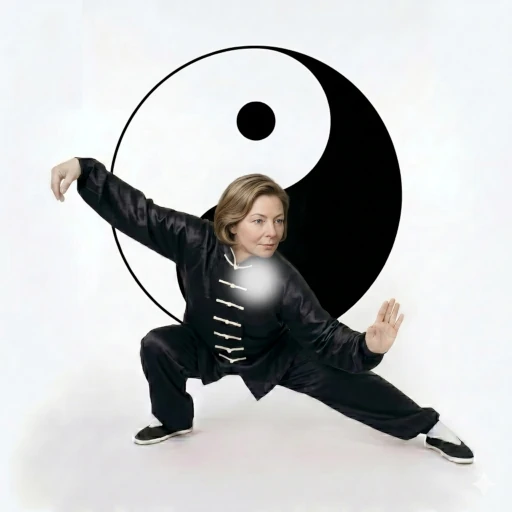
This binary system of two opposite elements is central to Chinese thought. You are probably familiar with this symbol: ☯. In the West, it is commonly called the Yin and Yang symbol, but its actual name is the Taijitu. This symbol represents the Taiji, or the Great Polarity. It is the universal force differentiated into two poles: Yin and Yang. The feminine and the masculine. The dark and the luminous. Negative and Positive. Earth and Heaven.
These opposite poles are not antagonistic, but rather complementary - their interaction gives rise to all phenomenological creation. If we observe the Taiji symbol carefully, we realize that each pole contains the seed of its opposite, and that one pole follows the other in an infinite succession, just as day follows night. This idea of mutability and cyclical succession of opposites is woven into the entire fabric of the I Ching.
Yin and Yang are, therefore, the fundamental binary elements - the letters - from which the 64 hexagrams of the I Ching are constructed. Yin, representing the feminine and dark, is depicted by a broken line, like this: ⚋. Yang, on the other hand, representing the masculine and luminous, is depicted by a solid line, like this: ⚊.
The Trigrams (The Words)#
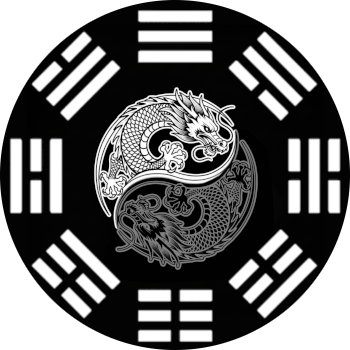
By stacking three Yin or Yang lines on top of each other, we obtain the 8 trigrams, which collectively are called the Bagua. These eight trigrams are fundamental symbols representing eight essential aspects of nature. Each trigrama has a name, is associated with a gender, holds a family relationship with the other trigrams, and possesses a specific quality or image.
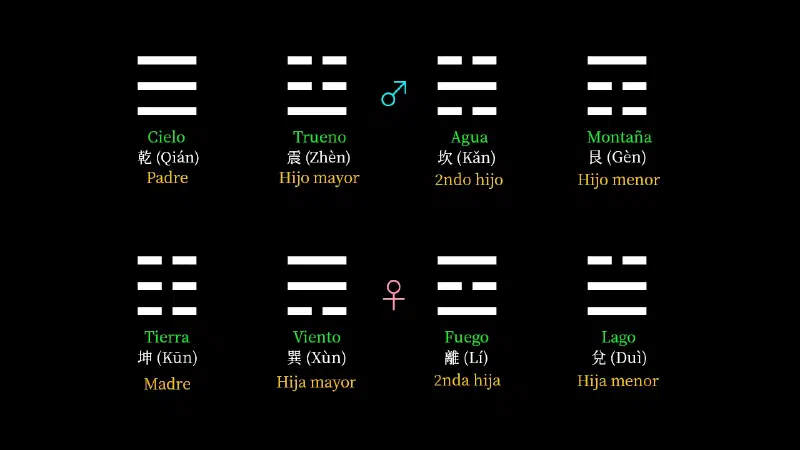
For example, three Yang lines give us the trigram ☰ Qián (乾), which represents Heaven, the father, the spirit, energy, the creative force, and the creative seed. Conversely, three Yin lines give us the trigram ☷ Kūn (坤), which represents the Earth, the mother, the receptive, and is associated with femininity, nourishment, and fecundity. We will delve deeper into the eight trigrams in a future article.
The Hexagrams (The Sentences)#
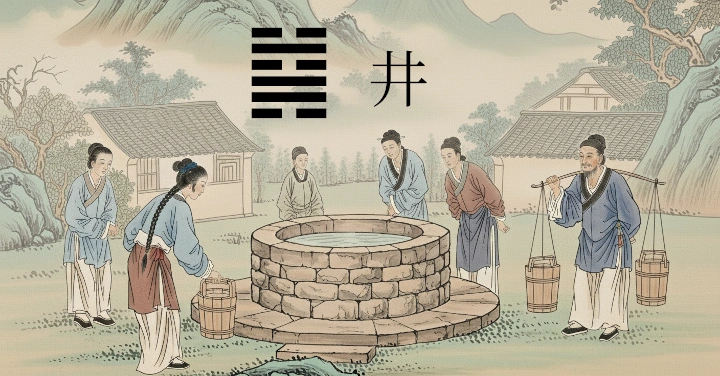
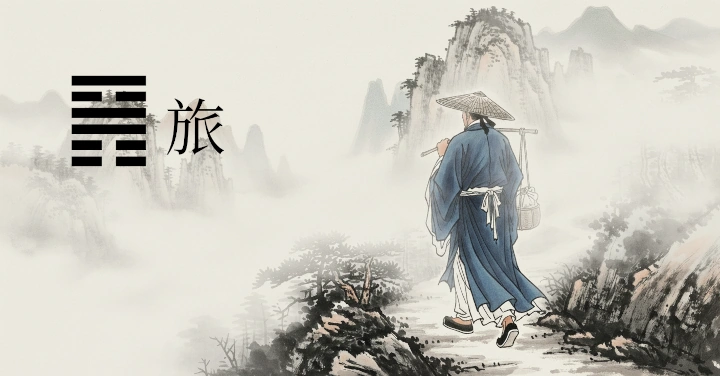
In turn, by placing a pair of trigrams one on top of the other, we obtain the 64 hexagrams, which constitute representative images of universal situations, whether on the earthly, celestial, or human plane. Sometimes, the names of these hexagrams allude to somewhat abstract concepts, such as “Possession in Great Measure” or “Modesty”, which are hexagrams 14 (䷍) and 15 (䷎), respectively. Other times, the hexagrams refer to more concrete entities, as is the case with hexagram 48 (䷯) - “The Well” and hexagram 56 (䷷) - “The Wanderer”.
For example, by combining the trigram ☷ Kūn (坤), which represents the earth, with the trigram ☲ Lí (离), which represents fire, we obtain hexagram 35 (䷢) in the sequence, named Jìn (晉), or Progress. Its image is that of the sun rising over the earth, representing an expansion and clarity of ever-increasing reach.
In summary, the I Ching reveals itself as a universal language. A binary alphabet of Yin and Yang shapes the eight primordial words of the trigrams, which in turn combine into the sixty-four sentences of the hexagrams: an ancestral dictionary whose wisdom allows us to read reality and its infinite mutations.
Complement your reading:#
If you prefer to deepen your understanding of these concepts visually and listen to a detailed analysis, I invite you to watch the full lesson on my channel:
You can also take a deep dive into how the I Ching codifies reality in this article: The I Ching and the Universe that Computes Itself