Quite recently, I saw a post on reddit with a very important question. So much so that I decided to write an article about it with my answer. Here is the original question:
What questions the i ching do not answer ?#
I am not asking “what is best to ask” (example “ask on how to be a better person”) Also i am not asking “how to phrase the questions so i can get the clearest answer” So not the usual yes/no questions debate (though if someone wants to add about this stuff above , than it is an appreciated bonus , but just as an added thing about the topic , so a good answer can be : " i ching does not answer questions about what is the tastiest food you can get today , and also you should ask i ching for advice and not “yes/no” questions if you want to get a clear answer" )
Some examples :
does i ching answer about the future ?
Does it give advice on how to win competitions ?
Does it give advice on what is the best way to fix your shoe ? ( mean answer on non psychological (of self or others) on pure physical stuff …. so what materials to use etc not just “fix it with modesty and perseverance” )
Also can it explain why stuff happened in the past ? (“why the shoe broke?” “why i failed the exam?” “why he was angry with me?” also “what did Napoleon said to this general?” " are the events in the bible true?" etc )
Can it help locate missing stuff ? ( can we locate all missing and kidnapped people ? can we locate our keys ? )
And of course i think this touches on what i ching really is …. is it some devine being that can tell you anything …. or is it just a tool to help you brainstorm
(*) The reason i write this post is cause i started to suspect maybe i ching is just a tool to help you think a bit clearer and that is it , so any question on how to deal with a situation would be just helping you think with clearer mind and not really the answer on what is best to do
Well let’s break this down from the most trivial answer to this question: Nothing prevents you from taking three coins (or opening my app) and asking the I Ching anything- the result of tossing three coins six times will be a hexagram with or without moving lines, and that result is the I Ching’s answer to your question. The I Ching will always reply, but whether its answer will be useful or meaningful to you in any way is a whole different matter…
Substance#
Then we cut straight to the question the reddit user is asking. They are not asking about form (avoid yes/no questions for example, or how to best phrase your question). They are asking about substance: what sort of questions can the I Ching answer (meaningfully)? Does it predict the future? Can it enlighten us on historical events of the past? Does it give us factually objective answers?
Underlying these questions, I sense that there is an assumption from the reddit user that the I Ching is some sort of divine, all knowing intelligence- in fact they ask that in the question. That assumption is in turn based on the notion that there must be one single universal objective truth, that given a certain or particular configuration of the Universe at some point in time, the laws that govern the Universe will result in another configuration at some later point in time, which is equivalent to saying that we could eventually predict the future, or, by running the laws backwards, infer the state of the Universe in an earlier point in time. That is essentially the postivist program, which has been undermined by the findings in 20th century quantum mechanics and fields like Chaos theory.
And the short answer is: no, the I Ching is not some sort of divine being or all knowing super-intelligence. The I Ching is more aligned with quantum mechanics, in the sense that the observer is an essential part of the system being observed, and the observer cannot detach himself from the system to observe reality objectively. Moreover, it must be said that the I Ching is designed to function like a mirror, propitiating the conditions for self-observation.
So what this means in practice is that although it is perfectly possble to ask the I Ching a question like “Who will will the midterm elections in the US on November?”, the answer and its interpretation will vary from querent to querent. This does not make the I Ching a good fortune-teller, but it makes it a hell of a great psycho-analyst.
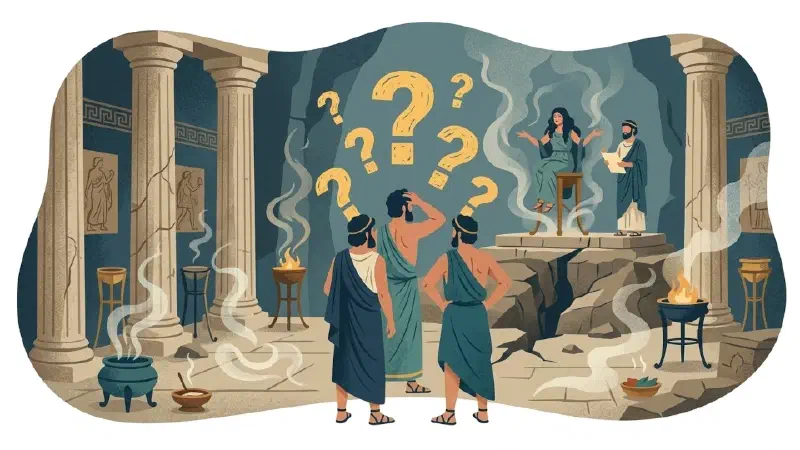
For those of us that care about the Oracle of Delphi’s injuction to “know thyself” (gnōthi seauton), the I Ching is among the best of tools there is. Counterintuitively, knowing yourself, and understanding the subconsicous assumptions that drive your reality is the most effective way to make sound decisions, and that is what the I Ching provides.
I previously said the I Ching is not an all knowing being. It is not an encyclopedia containing all the known facts in the Universe. It is not like an LLM trained on hundreds of thousands of texts. But it is not some entity spitting vague random symbols and metaphors back at us either.
It is more like a computer, or an universal analytic language that somehow encodes how the states of the world evolve into other states. So once the consultant’s own state is mapped onto its symbols, throught the ritual1 of tossing the coins, the resulting symbol and its moving lines (or absence thereof) offers an unparalled perspective of the question in relation to the person asking it.
To sum it all up, the structural limit of what the I Ching can answer meaningfully boils down to systems where the consultant is an active component, and the I Ching’s answer is a mirror of sorts of the beliefs and attitudes the consultant entertains, even subconsciously (and particularly in the subconscious).
At the end of the reddit question, the user poses the possibility that the I Ching is just a tool to help you think better, with an tone of dissapointment. I think, however, that this is the best thing that could be said of the I Ching in this day and age, when people consult LLM chatbots that appear to give knowledgeable answers, but are really just stochastic parrots prone to halucinating facts and sycophancy. Adulation and wrong facts given with absolute certainty surely do not a better thinker make.
And Form#
On an end note, and just to make this article about questions complete2, I would like to add that before posing a question to the I Ching, it is a good idea to phrase it carefully first. Yes/No questions are not typically advised because the I Ching, although its symbols are composed of binary, yes/no bits, does not answer in a yes/no fashion, but rather holistically, through symbols. The I ching’s answers are nuanced. For example, think how you would interpret hexagram 35 as an answer to “Should I go and see X?”
Either/or type questions should be definitely avoided- if the reply is “yes” or something equivalently, you would not know to which part of the question the I Ching’s answer refers. The way you phrase your question could also complicate its interpretation. For example, if your question is again something like “Should I go and visit X?”, any hexagram denoting action or crossing the water would point to yes, but if you phrase that question as “Should I remain home and not visit X?” (in the passive or negative), then how would you interpret a hexagram denoting action? Would that mean one should stay home? Or would that mean going out and seeing X?
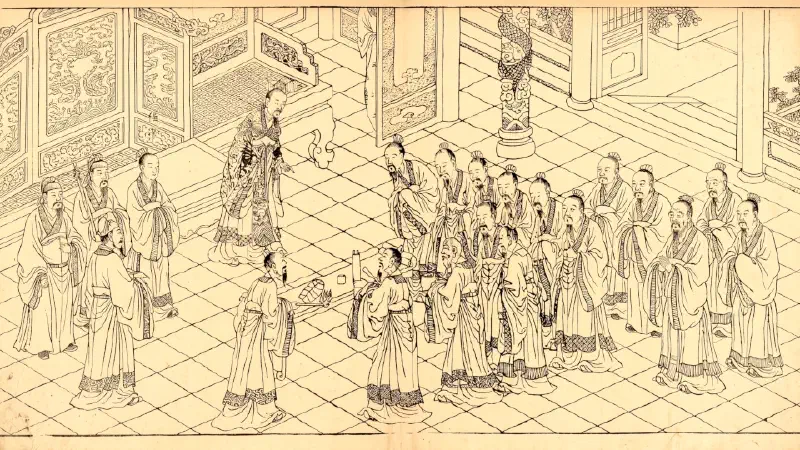
Finally, bear in mind that the ultimate purpose of the I ching is to align oneself with the Tao and help the individual become a superior man. Therefore, any question implicitly made with selfish gains or gaining power over another is not something I would advise.
Post scriptum#
The reddit user did ask if the I Ching could be used to locate missing stuff. There is in fact a method based on the I Ching, called six lines divination or Liu Yao, for precisely that. On my site, there is an app implementing this method, thats ready to use, and you can read about it here.
I am a bit hesitant to use the word ritual here because it has mystic or magical connotations for many people. However, it is a ritual because it requires a special state of mind or attitude on behalf of the querent for the method to work (see this article. ↩︎
See Hook, D. F. (1973). The I ching and you. Routledge & Kegan Paul. ↩︎